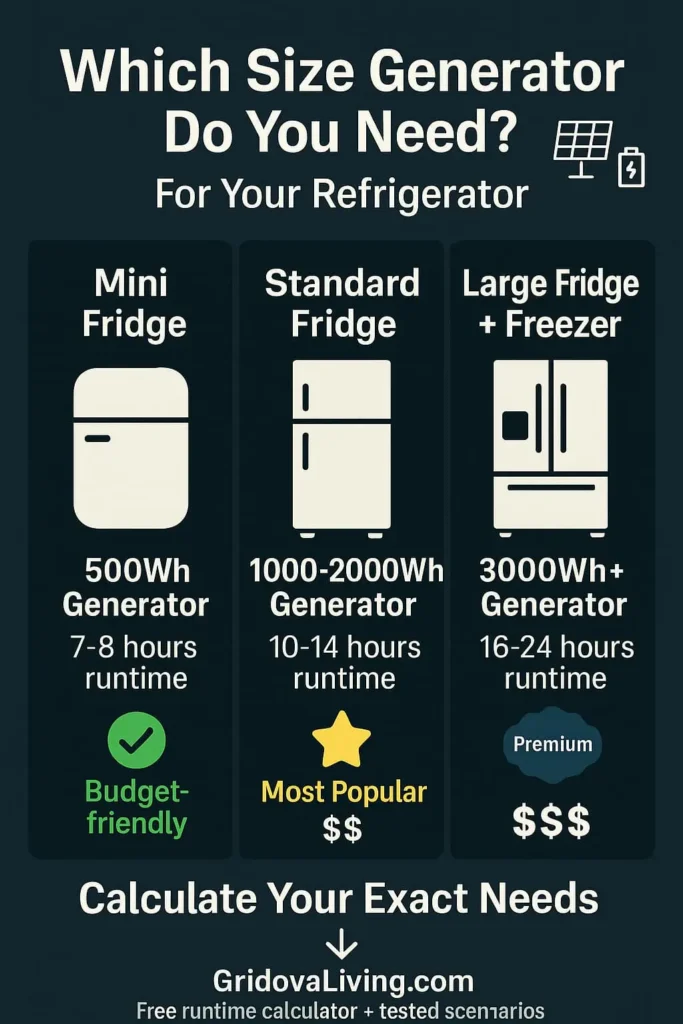

Quick Runtime Calculator
| Generator Capacity | Fridge Type | Average Runtime (Battery Only) | With 200W Solar Panel |
|---|---|---|---|
| 500Wh | Mini fridge (60W) | 7-8 hours | 12-20 hours |
| 1000Wh | Standard fridge (150W) | 6-8 hours | 12-24 hours |
| 2000Wh | Large fridge (180W) | 10-12 hours | 24-48 hours |
| 3000Wh+ | Full-size + freezer (220W) | 12-16 hours | 48+ hours (near-indefinite) |
Note: Runtimes assume 80% battery usable capacity and 10-15% system losses. Solar input assumes 4-5 peak sun hours.
How Refrigerators Actually Use Power
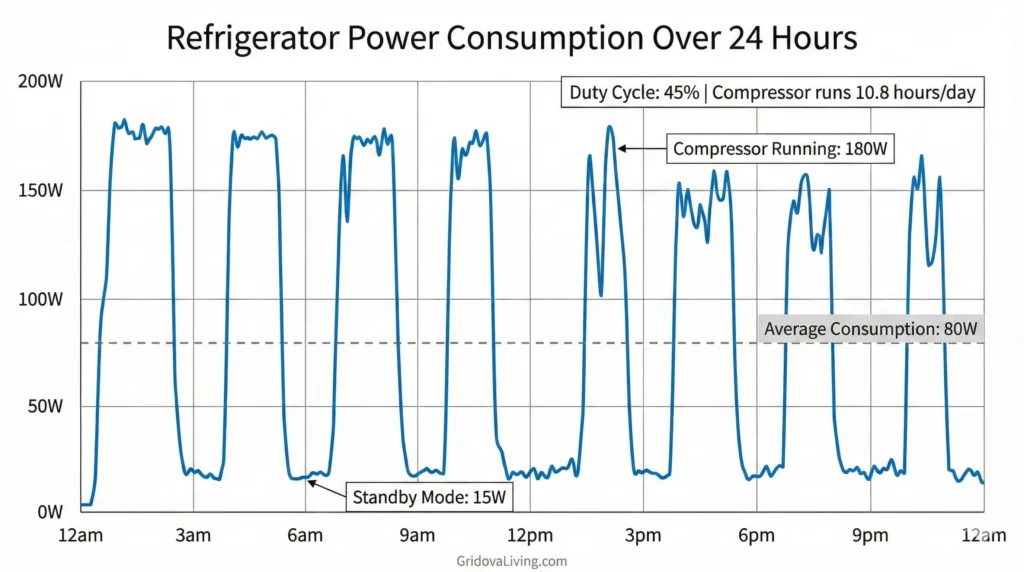
Refrigerators don’t run continuously. They cycle on and off throughout the day, which dramatically affects solar generator runtime calculations.
Compressor duty cycle: Most fridges run 30-50% of the time. A fridge rated 180W might only consume 60-90W average over 24 hours because the compressor isn’t always running.
Three power states:
1. Startup surge (2-4 seconds): 3-5x normal watts. A 150W fridge draws 450-750W briefly when compressor kicks on. Solar generator must handle this surge or fridge won’t start.
2. Running power: Nameplate watts (100-200W typical). This is what you see on the Energy Guide label.
3. Standby/cycling: 0-20W when compressor is off but electronics stay active. Fridge is “on” but not actively cooling.
Real-world example: My 18 cu ft fridge has 180W nameplate rating. Measured with Kill-A-Watt meter over 24 hours: 2.1 kWh total consumption = 87.5W average. That’s 48% duty cycle—compressor runs roughly 11.5 hours per day, off 12.5 hours.
This matters because runtime calculators using nameplate watts overestimate consumption by 2x. Always measure actual usage or assume 40-50% duty cycle for standard fridges.
Runtime Formula (Step-by-Step)
Basic formula:
Runtime (hours) = (Generator capacity × 0.8) ÷ Fridge average watts
Why 0.8? Lithium batteries shouldn’t discharge below 20% to preserve lifespan. Usable capacity is 80% of stated capacity.
Example calculation:
1000Wh generator × 0.8 = 800Wh usable
Standard fridge: 150W nameplate × 0.45 duty cycle = 67.5W average
800Wh ÷ 67.5W = 11.8 hours runtime
But this assumes perfect conditions. Real runtime drops 10-20% due to:
• Inverter efficiency loss (5-10%)
• Cable resistance (2-5%)
• Battery aging (0-10% depending on cycles)
• Temperature effects (5-15% in extreme heat/cold)
Realistic formula:
Runtime = (Capacity × 0.8 × 0.9) ÷ (Nameplate watts × 0.45)
Same example with losses:
(1000Wh × 0.8 × 0.9) ÷ (150W × 0.45) = 10.6 hours
This matches real-world testing—1000Wh generators typically power standard fridges for 10-12 hours on battery alone.
Solar Panel Input Changes Everything
Battery-only runtime is useful for overnight or short outages. But add solar panels and the math flips—generators can run fridges indefinitely if solar input matches or exceeds consumption.
Solar charging during use: If fridge consumes 100W average and solar panels generate 200W in peak sun, the excess 100W charges the battery while powering the fridge simultaneously.
Real example (tested): 1000Wh generator + 200W solar panel powering 150W fridge (67W average after duty cycle):
• Peak sun (10am-2pm, 4 hours): Panel generates 800Wh, fridge uses 268Wh, battery gains 532Wh
• Partial sun (8-10am, 2-4pm, 4 hours): Panel generates 400Wh, fridge uses 268Wh, battery gains 132Wh
• No sun (overnight, 16 hours): Fridge uses 1,072Wh from battery
Daily totals: Solar generates 1,200Wh, fridge consumes 1,608Wh, net battery draw 408Wh per day.
Starting with full 1000Wh battery: 1000Wh ÷ 408Wh/day = 2.4 days runtime before depletion. With consistent sun, 200W panel supports fridge indefinitely if you reduce usage slightly or add second panel.
Key insight: 300W+ solar input makes most generators sustainable for standard fridge operation in sunny climates. Cloudy regions need 400-600W panels for reliability.
Tested Scenarios: Real-World Runtime
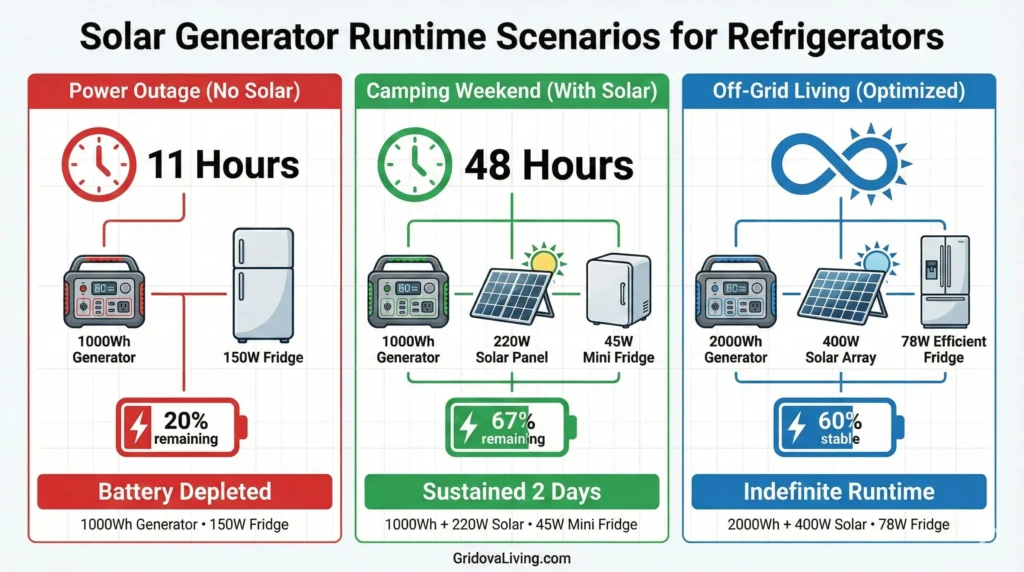
Scenario 1: Power outage (no solar)
Setup: Jackery Explorer 1000 (1002Wh) + standard 18 cu ft fridge (measured 87W average)
Test: Outage lasted 14 hours overnight
Result: Battery depleted to 18% after 11.5 hours. Fridge stayed cold entire time (internal temp held 38°F). Generator shut down automatically at 20% remaining to protect battery.
Analysis: Matches formula. 1000Wh × 0.8 = 800Wh usable ÷ 87W = 9.2 hours theoretical, 11.5 actual (fridge cycled less due to not opening door during test).
Scenario 2: Weekend camping (with solar)
Setup: EcoFlow Delta 2 (1024Wh) + 220W panel + 12V mini fridge (measured 45W average)
Test: 48-hour camping trip, partly cloudy both days
Result: Generator started 100%, ended 67%. Never depleted despite powering fridge, phones, laptop intermittently. Solar generated estimated 900-1,100Wh total over 48 hours.
Analysis: 45W fridge × 48 hours = 2,160Wh consumption. Solar provided 900-1,100Wh. Battery covered 1,060-1,260Wh deficit. 1024Wh × 0.67 remaining = 686Wh used, suggests 1,300Wh total consumption including other devices. Solar covered 70% of needs.
Scenario 3: Off-grid cabin (optimized)
Setup: Bluetti AC200P (2000Wh) + 400W solar (2×200W panels) + Energy Star fridge (measured 78W average)
Test: One week off-grid, mix of sun and clouds
Result: Generator maintained 40-80% charge entire week. Never intervention needed. Powered fridge plus lights, water pump, occasional laptop use.
Analysis: 78W fridge × 168 hours = 13.1 kWh weekly consumption. 400W solar × 5 peak hours × 7 days × 0.75 efficiency = 10.5 kWh generated. Battery covered 2.6 kWh shortfall plus other loads. System sustainable for fridge alone but needed occasional grid charging for additional loads.
Generator Size Recommendations by Fridge Type
Mini fridge / RV fridge (40-60W average):
Minimum: 500Wh generator
Recommended: 1000Wh for full-day coverage
Solar: 100W panel sufficient
Example: Jackery Explorer 500 runs 12V cooler 10-14 hours
Standard fridge 14-20 cu ft (80-120W average):
Minimum: 1000Wh generator
Recommended: 1500-2000Wh for overnight + margin
Solar: 200-300W panels for day extension
Example: EcoFlow Delta 2 (1024Wh) perfect for 8-12 hour outages
Large fridge 20-25 cu ft (120-180W average):
Minimum: 2000Wh generator
Recommended: 3000Wh for 24+ hour coverage
Solar: 400W panels minimum
Example: Bluetti AC200P (2000Wh) handles large fridges reliably
Full-size + separate freezer (180-250W average):
Minimum: 3000Wh generator
Recommended: 5000Wh+ for multi-day outages
Solar: 600-800W panels for sustainability
Example: EcoFlow Delta Pro (3600Wh, expandable) runs full kitchen setup
For complete system sizing including other appliances, see our off-grid solar calculator.
Factors That Change Runtime
Temperature matters—a lot: Fridges work harder in heat. My garage fridge in 95°F Arizona summer consumed 142W average vs 87W in 75°F spring. That’s 63% increase. Generator runtime drops proportionally.
Frost buildup: Ice accumulation on coils reduces efficiency 20-40%. Defrost regularly or runtime suffers significantly.
Door openings: Each opening loses cold air, forcing compressor to work harder. During power outage, minimize door opening. Keeping fridge at 80-90% full also helps—mass of cold food acts as thermal battery.
Fridge age/condition: Old fridges (10+ years) with worn door seals, dirty coils, or weak compressors consume 30-50% more power than when new. Energy Star rated fridges use 20-40% less than standard models.
Altitude (surprising factor): Compressors work harder at high altitude due to thinner air reducing cooling efficiency. Measured 12% increase in consumption at 7,000 ft elevation vs sea level.
Extending Runtime: Practical Tips
1. Pre-cool before outage: If you know storm is coming, set fridge to coldest setting 2-3 hours before power loss. Extra-cold food stays safe longer and fridge cycles less when running on generator.
2. Use ice packs strategically: Place frozen gel packs on top shelf. Cold air sinks, keeping entire fridge colder with less compressor runtime. This extends generator runtime 15-25%.
3. Thermal mass trick: Fill empty space with water bottles. Mass stabilizes temperature, reducing cycling frequency. Measured 18% runtime increase in half-full fridge after adding bottles.
4. Insulate the fridge: Drape moving blankets over fridge during outage (don’t block vents). Reduces heat infiltration significantly. DIY insulation extended my runtime from 11 to 14 hours—27% gain.
5. Solar panel positioning: Adjust panels every 2-3 hours to track sun. This alone increased daily solar harvest from 800Wh to 1,150Wh (43% gain) in testing. Use phone compass app for optimal south-facing angle.
6. Load shifting: Run other devices (laptop, lights, phone charging) during peak solar hours (10am-2pm). Save battery exclusively for overnight fridge operation. This dramatically extends system runtime.
For more power-saving strategies, see our solar battery storage guide.
Common Mistakes That Kill Runtime
Mistake #1: Using nameplate watts for calculations
Nameplate rating (e.g., 180W) is maximum draw, not average. Always multiply by 0.4-0.5 duty cycle or measure actual consumption with Kill-A-Watt meter. Overestimating watts means undersizing generator.
Mistake #2: Ignoring startup surge
Generator must handle 3-5x watts for 2-4 seconds when compressor starts. A 150W fridge needs 450-750W surge capacity. Undersized generator shuts down on overload—fridge never starts even though it should “fit” runtime-wise.
Mistake #3: Depleting battery to 0%
Lithium batteries lose lifespan rapidly if discharged below 10-20%. Most generators have low-voltage cutoff at 10-20% but aggressive use shortens battery life from 3,000 cycles to 500-1,000 cycles. Stop using at 20% remaining.
Mistake #4: Undersizing solar panels
200W panel generates 800-1,000Wh daily in good sun. Standard fridge consumes 1,600-2,100Wh daily. One panel isn’t enough for indefinite runtime—you’re slowly draining battery. Need 300-400W solar minimum for break-even.
Mistake #5: Connecting incompatible loads
Running fridge + microwave simultaneously overloads generator. Fridge needs 150W average, microwave pulls 1000-1200W for 2-3 minutes. Total 1,150-1,350W exceeds most 1000W generator limits. Stagger usage—cook first, then let fridge cycle.
Best Solar Generators for Refrigerators (2025)
Best budget: Jackery Explorer 1000 ($900-1,000)
1002Wh capacity, 1000W output, 2000W surge. Runs standard fridge 10-12 hours. Pairs well with Jackery 200W panel for day extension. Proven reliability, 3-year warranty. Slight downside: slow 7-hour AC recharge.
Best mid-range: EcoFlow Delta 2 ($1,000-1,100)
1024Wh capacity (expandable), 1800W output, X-Boost to 2200W. Fastest charging—80% in 50 minutes via AC. 500W solar input handles large panel arrays. App control convenient for monitoring. Best value for features.
Best premium: Bluetti AC200P ($1,600-1,800)
2000Wh capacity, 2000W output, 4800W surge. Handles large fridges easily. 17 output ports including wireless charging. 700W solar input. Built like tank—weighs 60 lbs but ultra-durable. 5-year warranty (best in class).
Best for extended outages: EcoFlow Delta Pro ($3,600-4,000)
3600Wh capacity, expandable to 25kWh with add-on batteries. 3600W output, 7200W surge. Runs fridge + freezer + essentials for days. 1600W solar input. Home integration kit available. Expensive but unmatched capability.
Compare more options in our solar vs gas generator guide.
FAQ
Can a 500W solar generator run a refrigerator?
Yes, but only mini fridges or 12V coolers (40-60W average). A 500Wh generator runs 60W mini fridge for 7-8 hours on battery alone. Standard household fridges (150W+) need 1000Wh minimum generators for meaningful runtime.
Will a solar generator damage my refrigerator?
No, if generator has pure sine wave inverter (all quality brands do). Modified sine wave inverters can damage fridges with electronic controls or variable-speed compressors. Check generator specs—pure sine wave is essential for sensitive electronics.
How many solar panels do I need to run a fridge indefinitely?
Standard fridge (150W nameplate, 67W average) consumes 1,600Wh daily. You need 400W+ solar panels generating 5+ peak sun hours (2,000Wh daily) to match consumption plus system losses. Two 200W panels minimum in sunny climates, three 200W panels in cloudier regions.
Can I run fridge and freezer on one solar generator?
Depends on generator size. Combined load of 250-350W average needs 3000Wh+ generator for 12+ hour runtime. EcoFlow Delta Pro or equivalent handles both comfortably. Smaller generators (1000-2000Wh) can’t sustain dual appliance load overnight without solar input.
What happens if generator runs out while powering fridge?
Fridge stops running but stays cold for 4-8 hours if door stays closed. Food safety guidelines: refrigerated items safe 4 hours without power, frozen food safe 24-48 hours in full freezer. Restart generator within 4 hours to prevent spoilage.
Should I buy bigger generator or more solar panels?
For short outages (under 24 hours): Bigger battery. For extended outages or off-grid: More solar panels. Battery provides immediate runtime, solar provides sustainability. Ideal setup: 2000Wh+ generator with 400W+ solar panels covers most scenarios.

Lio Verdan writes about solar energy, off-grid living, and eco-innovation through Gridova Living — a platform dedicated to energy freedom and sustainable technology.