
Quick Winter Solar Facts
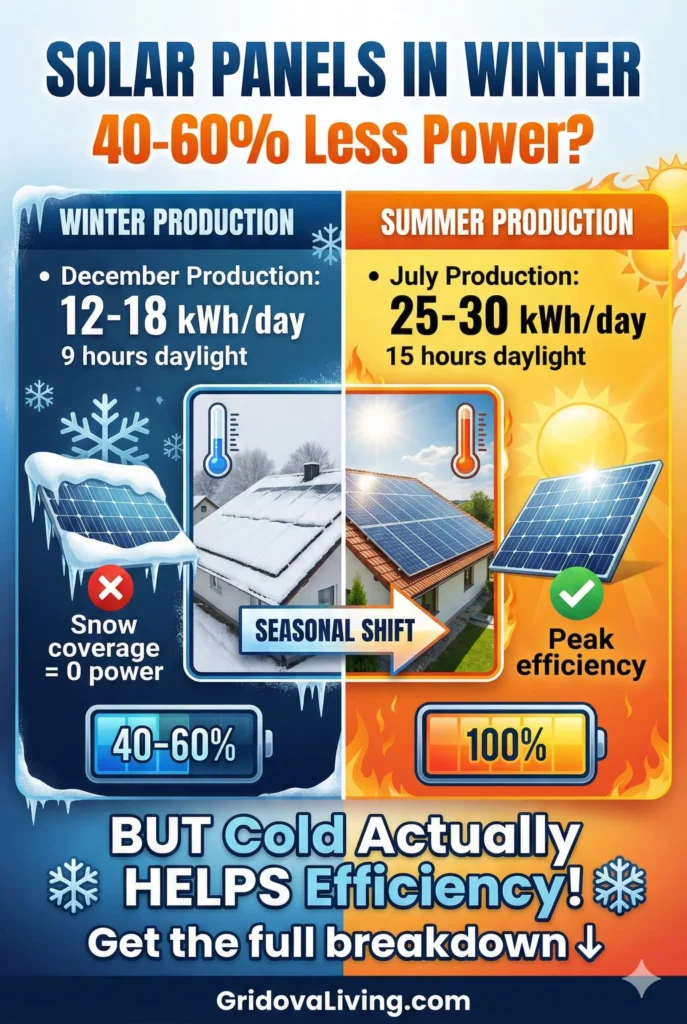
| Factor | Winter Impact | Production Change |
|---|---|---|
| Temperature | Cold = better efficiency | +10-15% per panel |
| Daylight Hours | 9 hours vs 14 summer | -35% total production |
| Sun Angle | Low angle = less direct | -20% intensity |
| Snow Coverage | Blocks all production | -100% when covered |
| Cloud Cover | More frequent | -40-60% on cloudy days |
| Net Effect | Combined factors | 40-60% of summer output |
Cold Weather Actually Helps Panels
This surprises people: solar panels are more efficient in cold weather. Every degree below 77°F improves output by roughly 0.5%. At 32°F, that’s a 22% efficiency boost compared to a 77°F baseline.
Why? Solar panels are semiconductor devices. Heat increases electrical resistance. Cold reduces resistance, letting electrons flow more freely. Less energy lost as heat means more electricity produced.
Germany produces massive solar energy despite cold winters. Their panels work better in November than July simply because of temperature. The trade-off is fewer daylight hours.
The Real Problem: Shorter Days
Winter days are brutal for solar production. December in Denver gets 9.5 hours of daylight versus 15 hours in June. That’s 37% less time to generate power—and that’s before accounting for lower sun angle.
Lower sun angle matters too. Summer sun hits panels nearly perpendicular at noon. Winter sun stays low on the horizon—even at solar noon, it’s hitting panels at a shallow angle. Less direct sunlight means less energy captured.
Combined effect: A panel producing 300W in summer might only hit 120-180W on a clear winter day. Not because the panel is failing—just physics and geometry.
This is why proper panel angle matters. Steeper angles catch more winter sun but sacrifice summer production.
Snow Coverage Kills Production Completely
Snow on panels = zero production. Even a light dusting blocks 80-90% of sunlight. Two inches of snow? Panel is essentially off.
Good news: Snow doesn’t usually stick long. Dark panel surfaces absorb heat on sunny days. Snow slides off naturally, especially on tilted panels. Panels angled 30°+ shed snow within hours after sun comes out.
Bad news: Heavy snow or ice can sit for days. Multi-day storms with continuous snow means extended production loss. This is where battery banks earn their keep—you need stored power to bridge gaps.
How to Remove Snow Safely
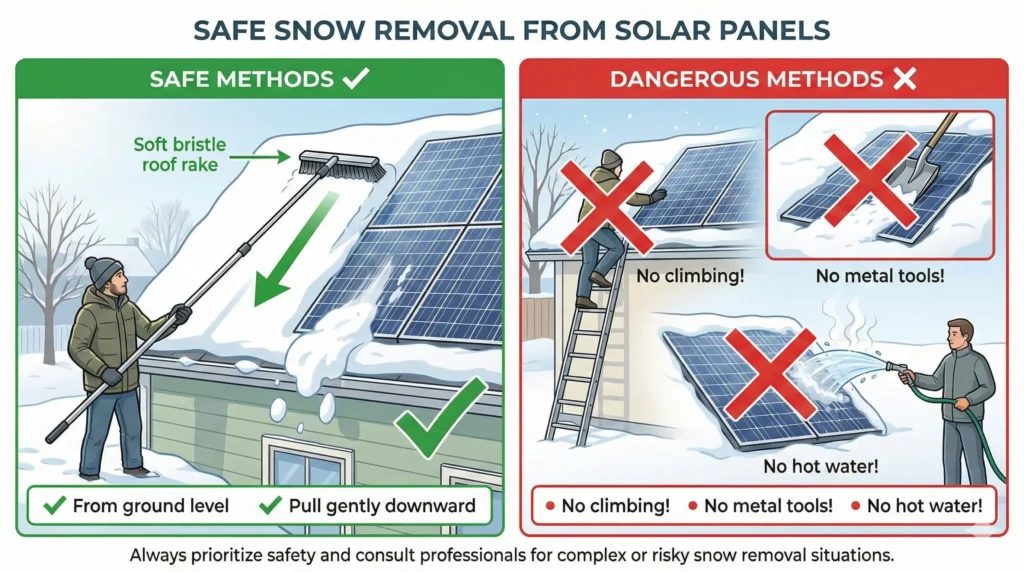
Best method: Wait for sun to melt it. Seriously. Don’t climb on snowy roofs. Panels will shed snow naturally once sun hits them—usually within 2-4 hours of sunrise.
If you must clear snow:
Use a soft-bristle roof rake from the ground. Pull snow DOWN off panels gently. Don’t push or scrape—you’ll scratch anti-reflective coating.
The SNOW JOE Roof Rake has a soft rubber head that won’t scratch panels and extends to 21 feet—enough to reach most residential roof panels from the ground. It’s specifically designed for shingle roofs but works perfectly for solar panels too.
Never use metal tools. No shovels, no scrapers, no ice picks. You’ll crack cells or scratch coatings. A $15 scratch can cost $500 in lost efficiency over panel lifetime.
Don’t spray hot water. Rapid temperature change can crack cold panels. If you must use water, lukewarm only.
For hard-to-reach panels, leave them alone. Production loss for a few days beats roof fall injuries or damaged panels.
Some people install heating cables along panel bottoms. These melt snow from below, letting it slide off. Costs $100-200 per array but works for heavy snow climates. Just remember: heating cables consume power, reducing net benefit.
Winter Production Is Still Worth It
Even at 40-50% summer production, winter solar beats no solar. A 5kW system producing 10-12 kWh/day in winter still covers basics—lights, refrigerator, electronics, heating controls.
Grid-tied systems credit your account for any excess. Winter underproduction gets balanced by summer overproduction with net metering. Annual production is what matters, not monthly.
Off-grid systems need realistic expectations. Size your solar array and battery bank for worst-case winter production—not summer peaks. December should be your design month, not July.
Does Cold Damage Solar Panels?
No. Quality panels are rated to -40°F. Cold doesn’t harm them—they’re built for it. Heat is actually harder on panels than cold.
Rapid temperature swings can stress panels slightly. Going from -10°F overnight to 40°F midday causes expansion/contraction. But panels are designed for this. Thermal cycling is part of certification testing.
Ice forming under panel frames can cause issues if water seeps in and freezes. Proper installation with sealed edges prevents this. If your panels were installed correctly, ice isn’t a problem.
Snow weight? Also not an issue. Panels are engineered for 50+ pounds per square foot. That’s several feet of heavy, wet snow. Normal snowfall won’t damage them.
Optimizing for Winter Production
Steeper panel angle helps. Winter sun is low. Tilting panels steeper (latitude + 15°) catches more winter sun. You sacrifice some summer production, but winter gains matter more for off-grid reliability. See our angle optimization guide.
If your panels are flat-mounted, consider adding adjustable tilt brackets. These let you change angle seasonally—steeper in winter for better snow shedding and sun capture, flatter in summer for peak production. Takes 20 minutes to adjust twice a year.
Keep panels clean. Dirt and grime block light. In winter when every photon counts, clean panels matter more. A dirty panel loses 15-20% output. Check our cleaning guide for safe methods.
Clear obstructions. Trees that don’t shade in summer might shade in winter when sun is lower. Trim branches or relocate panels if possible.
Add capacity. If you regularly run out of power in winter, you need more panels or batteries. Oversizing by 20-30% handles winter dips without generator backup.
The SNOW JOE Roof Rake has a soft rubber head that won’t scratch panels and extends to 21 feet—enough to reach most residential roof panels from the ground. It’s specifically designed for shingle roofs but works perfectly for solar panels too.
Real-World Winter Performance Example
System: 5kW (5,000W) array in Colorado (40° latitude)
Summer production (July):
– 5-6 full sun hours/day
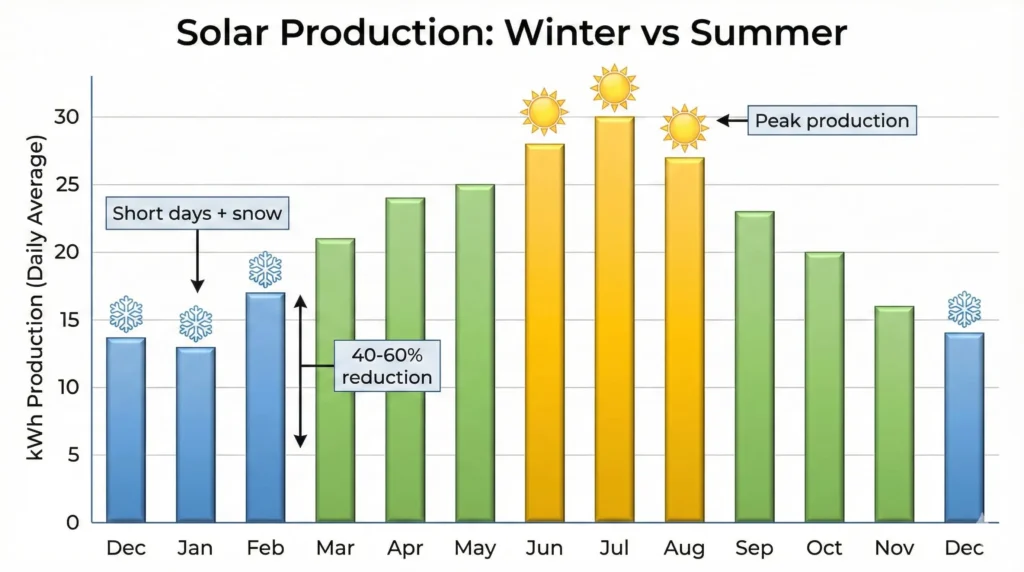
– 25-30 kWh/day average
– Enough for all loads + excess
Winter production (January):
– 3-4 full sun hours/day
– 12-18 kWh/day average
– Covers essentials, tight on heavy use days
– Snow days: 0-5 kWh (batteries carry you)
Annual average: 20-22 kWh/day, enough for typical off-grid home
The key is accepting winter variability and planning accordingly. You won’t have AC in winter anyway, so lower production aligns with lower demand.
FAQ
Do solar panels work with snow on them?
No. Snow blocks sunlight completely. Even a thin layer cuts production 80-90%. Panels must be clear to generate power. Most snow slides off naturally within hours of sunrise on tilted panels.
Are solar panels less efficient in winter?
Actually more efficient per watt of sunlight—cold improves semiconductor performance. But total production drops 40-60% due to shorter days, lower sun angle, and occasional snow coverage.
How do I remove snow from solar panels?
Best method: wait for sun to melt it naturally. If needed, use soft-bristle roof rake from ground. Never climb on snowy roofs or use metal tools. Don’t spray hot water—temperature shock can crack panels.
Can solar panels freeze?
Panels themselves don’t freeze—they’re solid state devices. Ice can form on the surface but doesn’t damage panels. Quality panels are rated to -40°F. Cold weather doesn’t harm them.
Should I adjust solar panel angle for winter?
If your mounts allow adjustment, yes. Increase angle by 10-15° in winter to catch lower sun. This boosts winter production 15-20% while slightly reducing summer output. See our angle guide for specifics.
How much less power do solar panels make in winter?
Typically 40-60% of summer output. A system producing 30 kWh/day in July might produce 12-18 kWh/day in January. Exact reduction depends on latitude, weather, and snow frequency.
Bottom Line
Solar panels work fine in winter. Cold helps efficiency. The challenges are shorter days, lower sun angle, and snow coverage—not cold itself.
Production drops 40-60% compared to summer, but that’s predictable and manageable. Size your system for winter production if you’re off-grid. Grid-tied users rely on net metering to balance seasonal variations.
Don’t obsess over snow removal. Panels shed snow naturally in most cases. Focus on proper angle, keeping panels clean, and having adequate battery storage to bridge cloudy periods.
Winter solar works. It’s just different from summer solar. Plan accordingly and you’ll have reliable power year-round.
For complete system planning, check our guides on battery wiring and starting off-grid life.

Lio Verdan writes about solar energy, off-grid living, and eco-innovation through Gridova Living — a platform dedicated to energy freedom and sustainable technology.