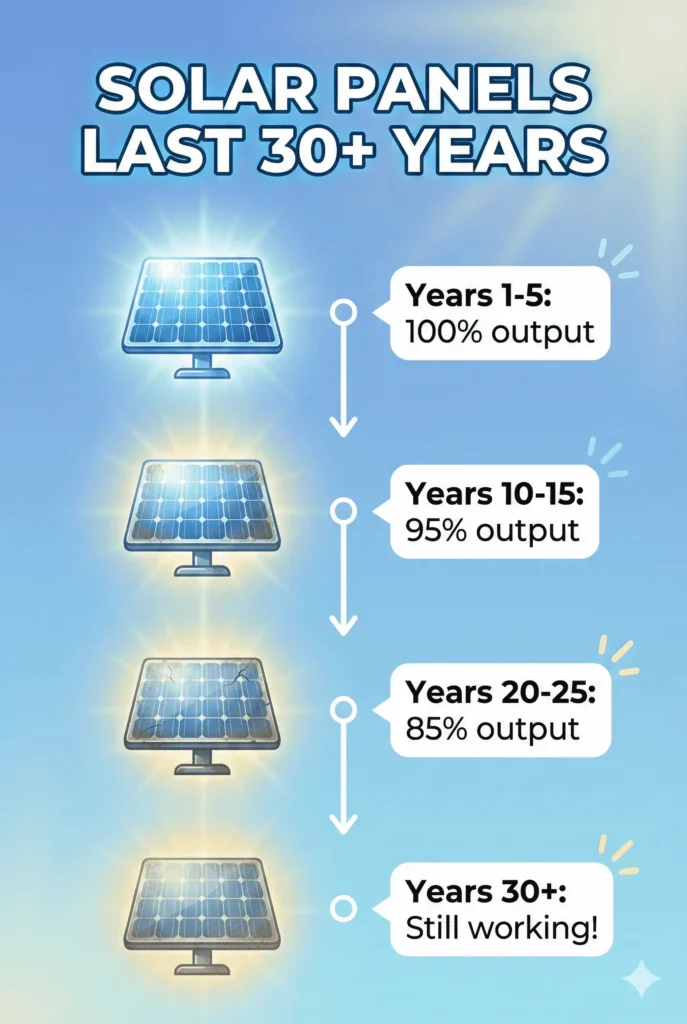

I’ve seen 20-year-old panels still cranking out 85% of their original output. I’ve also seen 10-year-old cheap panels barely making 60%. Quality matters more than marketing claims.
Here’s what actually determines how long your panels will last and when you should think about replacing them.
The 25-Year Standard (And What It Really Means)
Most solar panels come with a 25-year performance warranty. But that doesn’t mean they die at 25 years. It means the manufacturer guarantees they’ll still produce at least 80-85% of their original rated power after 25 years.
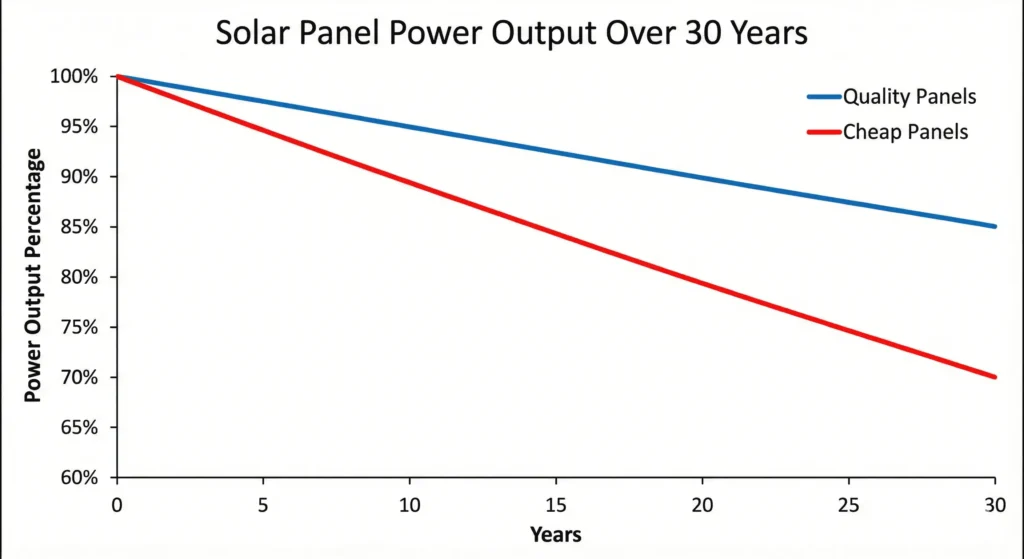
The actual lifespan is longer. Quality panels degrade about 0.5% per year. Cheap panels might degrade 0.8-1% per year. Do the math:
Quality panel: After 30 years → 85% output remaining. Still useful.
Cheap panel: After 30 years → 70% output remaining. Marginal.
This is why going with reputable manufacturers matters. That extra upfront cost buys you 5-10 more years of useful life. For a complete breakdown of which panels actually last, check our guide on the best solar panels for off-grid systems.
What Actually Makes Panels Fail
Panels don’t just stop working one day. They degrade gradually. But certain things speed up that process or cause outright failure.
UV damage: Sun exposure breaks down the materials slowly. This is normal degradation—you can’t avoid it. Better materials degrade slower.
Temperature cycling: Panels expand in heat, contract in cold. This stresses solder joints and creates micro-cracks over thousands of cycles. Panels in extreme climates age faster.
Moisture intrusion: If seals fail, water gets inside. This corrodes connections and shorts out cells. Once moisture is in, the panel is basically done.
Physical damage: Hail, falling branches, or just someone walking on them wrong. Cracked glass or broken cells kill output fast.
Poor installation: Bad mounting that allows flexing, insufficient ventilation causing overheating, or loose connections creating hot spots. Installation quality directly impacts lifespan.
Real-World Performance by Age
Based on data from actual installations, here’s what to expect:
Years 1-5: Panels perform at or near rated output. Some even exceed specs when new. Very little degradation. This is the honeymoon period.
Years 5-15: Gradual decline. Quality panels drop to 95-97% of original output. You won’t notice this in daily use. Everything still works fine.
Years 15-25: More noticeable decline. Output drops to 85-90%. Your system still meets most of your power needs but you might notice slightly less production than when it was new.
Years 25-30: Performance depends heavily on quality and maintenance. Good panels at 80-85%. Cheap panels might be at 70-75%. At this point, you’re deciding whether to keep them or upgrade.
Years 30+: Many panels keep working. I’ve seen 35-year-old panels still producing 75% output. They’re less efficient than new panels but they still generate power. Often worth keeping until they fail completely.
Do You Really Need to Replace Them?
Just because panels are old doesn’t mean you should replace them. Here’s when replacement actually makes sense:
Physical damage: Cracked glass, broken cells, water inside. These won’t heal. Replace damaged panels immediately—they can create safety issues.
Output below 60%: If testing shows panels producing less than 60% of rated power, they’re not worth keeping. You’re losing too much production.
System expansion: If you’re adding capacity anyway, might as well upgrade old panels at the same time. Mixing very old and very new panels isn’t ideal.
Roof replacement: If you’re re-roofing, consider whether 20-year-old panels are worth reinstalling. Might be time for an upgrade while everything is already torn apart.
Technology leap: Modern panels produce 50-100% more power per square foot than panels from 20 years ago. If roof space is limited, upgrading can significantly increase your system capacity.
Otherwise? If they’re still producing 70%+ and not damaged, keep using them. Free power is free power, even at reduced efficiency.
How to Make Panels Last Longer
You can’t stop degradation completely, but you can slow it down.
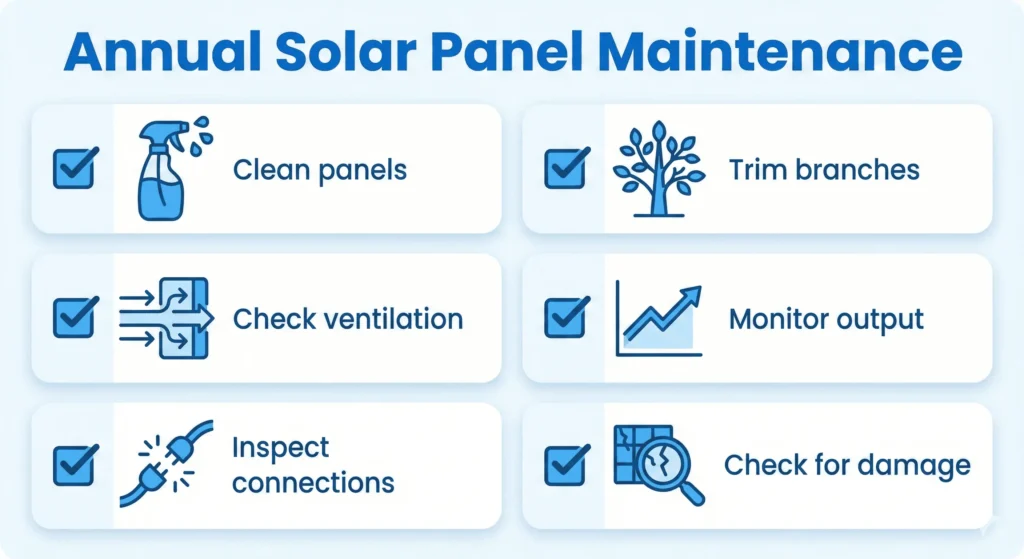
Keep them clean. Dust, pollen, and bird droppings reduce output and create hot spots. Clean panels 2-3 times per year. Our solar panel cleaning guide has the full process.
Ensure good ventilation. Panels that run cooler last longer. Make sure there’s airflow underneath—don’t mount them flush to the roof. Two inches minimum clearance.
Check connections annually. Loose connections create resistance, resistance creates heat, heat damages panels. Tighten everything once a year.
Trim overhanging branches. Shade reduces output. Falling branches cause damage. Keep trees trimmed back from your array.
Monitor performance. If you notice sudden drops in production, investigate immediately. Catching problems early prevents bigger damage.
Don’t walk on them. If you must access the roof, step on mounting rails, not the panels themselves. Micro-cracks from foot traffic accumulate over time.
Inverters Die Before Panels Do
Here’s something most people don’t realize: your inverter will probably need replacing before your panels do.
Inverters typically last 10-15 years. Some newer models claim 20-25 years, but the track record isn’t there yet. Inverters have electronics that wear out—capacitors, cooling fans, circuit boards. Panels are mostly just silicon and glass.
Budget for at least one inverter replacement during the life of your solar system. Maybe two. This is normal and expected. If you’re setting up an off-grid system, read our inverter selection guide to choose one that lasts.
The good news? Inverters are getting cheaper and better. When your 15-year-old inverter dies, the replacement will probably be more efficient and cost less than the original.
Warranty vs Actual Lifespan
Don’t confuse warranty length with how long panels actually work.
Product warranty covers defects and failures. Usually 10-12 years. This means if the panel stops working due to manufacturing defects, they’ll replace it.
Performance warranty guarantees power output. Usually 25 years at 80-85% output. This is about degradation rate, not failure.
Neither warranty means the panels die when it expires. It just means the manufacturer won’t cover problems after that point. Many panels outlast their warranties by a decade or more.
That said, good warranties indicate manufacturer confidence. A company offering 25-year warranties believes their panels will last. A company offering 10-year warranties is hedging their bets.
What About Battery Lifespan?
If you’re running off-grid, your battery bank will need replacement long before your panels do.
Lithium batteries: 10-15 years typical lifespan. Some claim 20 years but real-world data is still limited. Expensive upfront but long-lasting.
Lead-acid batteries: 5-8 years for AGM, 3-5 years for flooded. Cheaper initially but need replacing more often. Multiple replacement cycles over the life of your panels.
Your panels might last 30 years, but you’ll replace batteries 2-4 times during that period. Factor this into your budget. Our battery storage guide covers the real costs and lifespan expectations.
Older Panels vs New Technology
Should you replace working old panels just to get newer technology? Usually not, unless space is really tight.
Modern panels are more efficient—20-22% vs 14-16% from 15 years ago. But efficiency doesn’t matter if you have room for more panels. It’s usually cheaper to add panels than replace working ones.
The one exception: if you’re severely space-constrained. Upgrading from 15-year-old 200W panels to modern 400W panels means double the power in the same space. That might justify replacement even if the old panels still work.
For most people though, keep old panels running until they fail. Add more panels if you need more capacity. This is the most cost-effective approach.
End of Life: Recycling Solar Panels
When panels finally do die, don’t just throw them in the trash. Solar panels contain materials that should be recycled.
Glass, aluminum frames, copper wire—all recyclable. Silicon cells can be processed and reused. Some manufacturers have take-back programs. Check with your installer or local recycling centers.
The solar recycling industry is still developing, but it’s getting better. By the time your panels reach end of life, recycling infrastructure will probably be more established than it is now.
Signs Your Panels Are Dying
How do you know when panels are actually failing vs just aging normally?
Sudden output drop: If production drops 20%+ suddenly, something’s wrong. Could be a failed connection, damaged cell, or inverter issue.
Visible damage: Cracks in glass, burn marks, discoloration, or delamination (layers separating). These indicate damage that will get worse.
Hot spots: If you can see areas of panels that are noticeably hotter than others (use an infrared thermometer), cells are failing in that area.
Physical warping: Panels should be flat. If they’re bowing or warping, the frame is failing or moisture has gotten inside.
Corrosion: Rust on frames, green corrosion on connections, or visible moisture inside the panel. All bad signs.
Normal aging looks like gradual decline in output over many years. Failure looks like sudden drops or visible damage. Know the difference.
Can you extend panel life beyond 30 years?
Yes, with proper maintenance. Keep them clean, ensure good ventilation, check connections regularly, and protect from physical damage. Quality panels can hit 35-40 years still producing 70-75% of original output.
What fails first on solar panels?
Usually not the cells themselves. Junction boxes, solder joints, and frame seals typically fail before the actual solar cells do. Moisture intrusion from failed seals is a common end-of-life cause.
Are 20-year-old solar panels worth keeping?
If they’re still producing 75%+ of rated output and not damaged, yes. Free power at 75% efficiency is still free power. Replace them when output drops below 60% or if they’re physically damaged.
Do solar panels work after 25 years?
Absolutely. The 25-year warranty is just a guarantee of minimum performance, not an expiration date. Most quality panels keep working well beyond 25 years, just at slightly reduced efficiency.
How often should I test my solar panels?
Check output monthly just by looking at your monitoring system. Do a detailed inspection twice a year. Test actual output with proper equipment every 3-5 years to track degradation rate.
Can damaged solar panels be repaired?
Minor issues like loose connections can be fixed. But cracked cells, broken glass, or moisture intrusion usually can’t be repaired cost-effectively. Replacement is typically the better option.
What’s the shortest solar panel lifespan you’ve seen?
I’ve seen cheap no-name panels fail in 5-7 years from moisture intrusion and rapid degradation. This is why buying quality panels with good warranties matters. Cheap panels rarely reach even 15 years.
Final Thoughts
Solar panels are built to last. Quality panels will outlive most of the other components in your system—inverters, batteries, wiring—everything else will need replacement first.
Don’t stress about the 25-year mark. It’s not a deadline. It’s just when the manufacturer stops guaranteeing peak performance. Your panels will keep working, just gradually producing a bit less each year.
Focus on maintenance and monitoring. Keep them clean, watch for damage, and check performance regularly. Do this and your panels might still be generating power when you’re old and gray.
And when they finally do reach end of life after 30+ years? You got three decades of free power from the sun. Not a bad investment.
If you’re planning a new installation and want to ensure maximum longevity, start with our solar system sizing guide to build it right from day one.

Lio Verdan writes about solar energy, off-grid living, and eco-innovation through Gridova Living — a platform dedicated to energy freedom and sustainable technology.