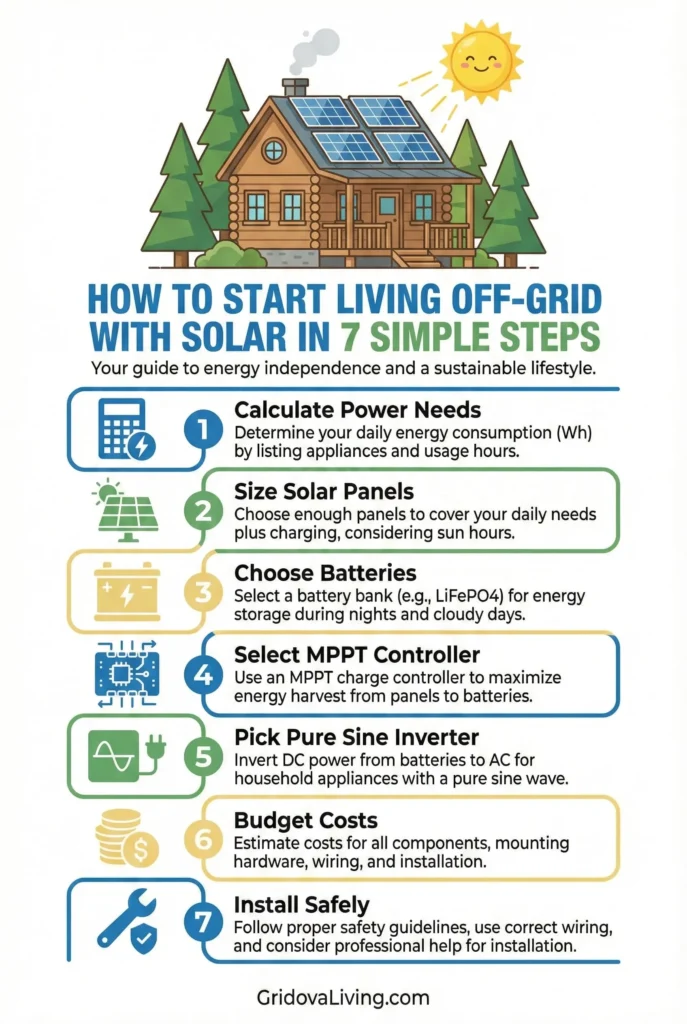

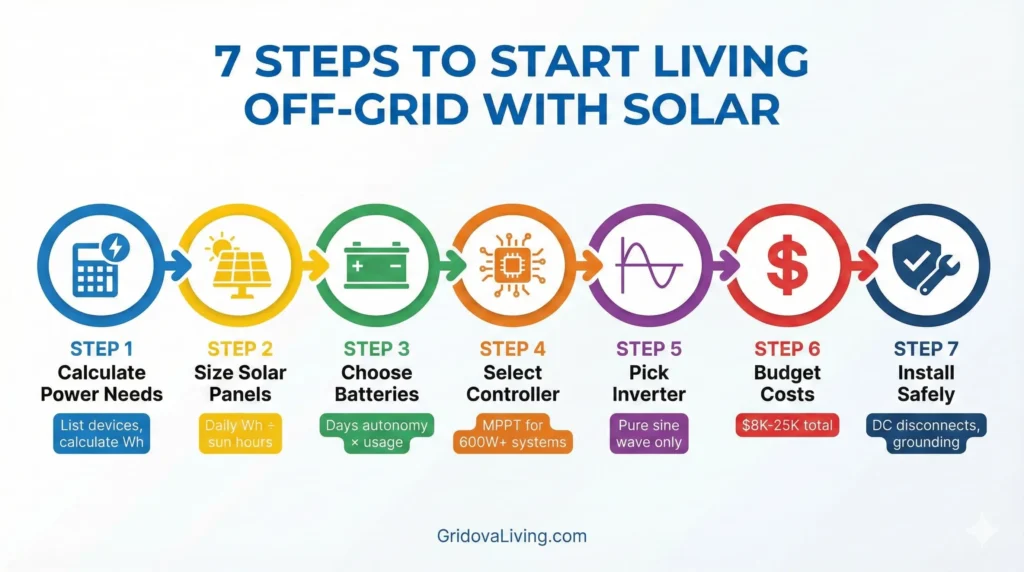
 Here’s how to go off-grid with solar in seven practical steps.
Step 1: Calculate Your Power Needs (Don’t Skip This!)
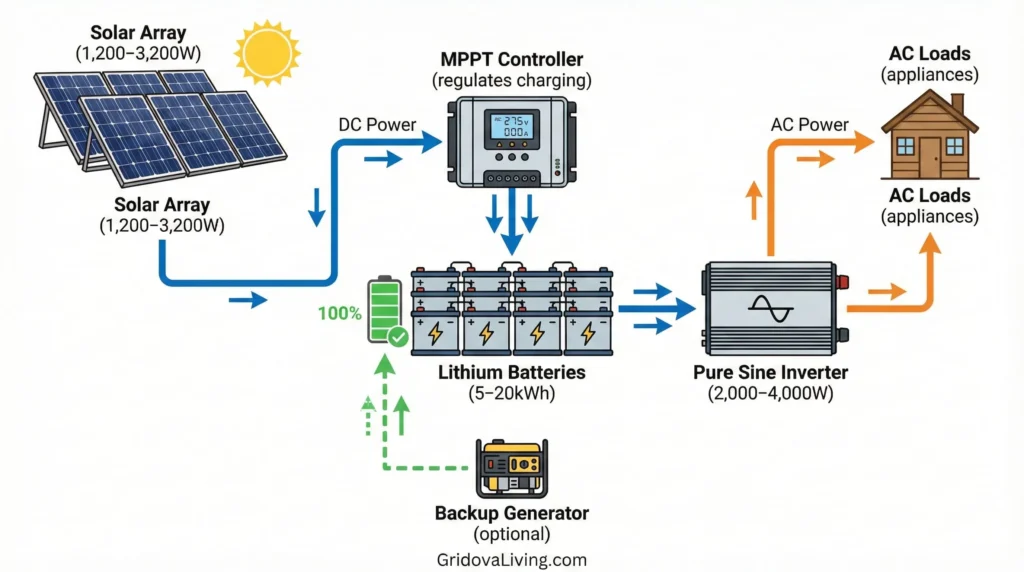
Most off-grid failures start here—people guess their power needs instead of calculating them. Undersizing means running out of power. Oversizing wastes thousands of dollars.
The power audit process:
List every device you’ll use off-grid. Include lights, fridge, water pump, laptop, phone chargers, TV, power tools—everything.
Find each device’s wattage (check label, manual, or wattage meter). If label says amps, multiply amps × voltage (usually 120V) to get watts.
Estimate daily usage hours for each device.
Calculate watt-hours: Device watts × hours used = daily Wh. Sum all devices for total daily watt-hours.
Example calculation:
| Device | Watts | Hours/Day | Wh/Day |
|---|---|---|---|
| LED lights (6) | 60W | 5h | 300Wh |
| Fridge | 150W | 12h | 1,800Wh |
| Laptop | 65W | 6h | 390Wh |
| Water pump | 800W | 0.5h | 400Wh |
| Phone chargers (2) | 20W | 3h | 60Wh |
| TV | 100W | 3h | 300Wh |
| TOTAL: | 3,250Wh | ||
Note: Fridge uses 150W when compressor runs but cycles on/off. Actual daily consumption shown assumes 12-hour duty cycle.
Add 20-30% safety margin for inefficiencies. 3,250Wh × 1.25 = 4,062Wh daily need.
Use our detailed solar calculator for precise system sizing.
Step 2: Size Your Solar Panel Array
Formula: Panel watts = (Daily Wh ÷ Peak sun hours) × 1.3 loss factor
Example: 4,062Wh ÷ 4.5 hours × 1.3 = 1,173W → Round to 1,200W (four 300W panels)
Peak sun hours vary: Arizona 5-7h, Pacific Northwest 3-4h. Many install 30-50% extra for winter cushion.
See our best off-grid solar panels guide.
Step 3: Choose Battery Storage
Formula: Battery kWh = (Daily Wh × Days autonomy) ÷ DOD ÷ 1000
Example: (4,062Wh × 3 days) ÷ 0.8 ÷ 1000 = 15.2 kWh
| Type | DOD | Lifespan | Cost/kWh |
|---|---|---|---|
| Lead-Acid | 50% | 3-5yrs | $150-250 |
| AGM | 50% | 5-7yrs | $250-350 |
| Lithium | 80-90% | 10-15yrs | $400-600 |
Lithium costs 2-3x upfront but saves $14,000 over 15 years vs lead-acid replacements.
Step 4: Select Charge Controller
PWM: $50-200, 75-80% efficient, small systems only
MPPT: $150-800, 94-98% efficient, 20-30% more harvest, required for 600W+ systems
MPPT pays for itself in 1-2 years. See configuration guide.
Step 5: Choose Inverter
Pure sine wave only (protects electronics). Size for largest simultaneous load plus surge capacity.
Example: 375W continuous + 450W surge = need 1,000-1,500W inverter with 3,000W+ surge rating.
Step 6: Budget and Costs
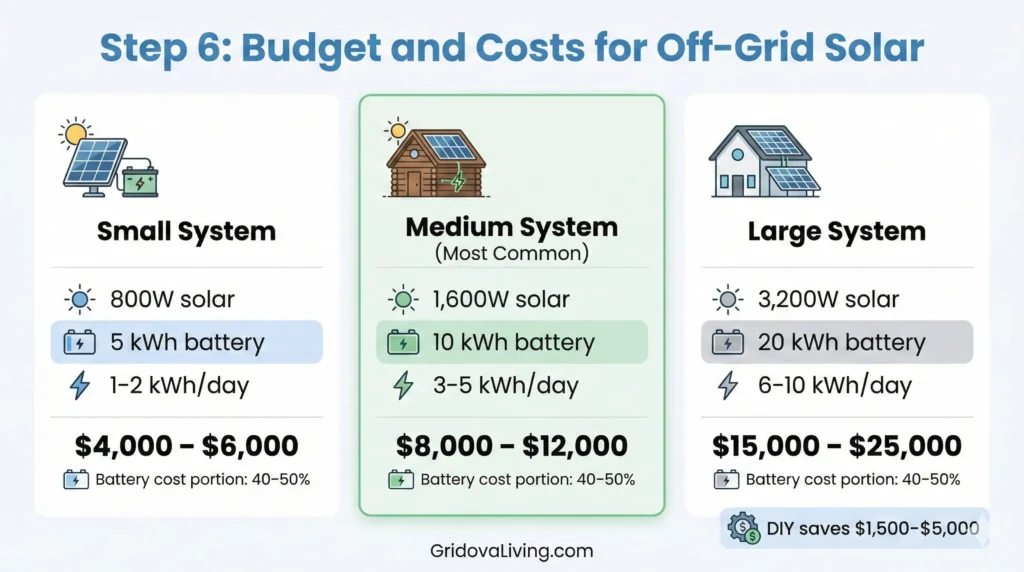
| System Size | Daily Use | Total Cost |
|---|---|---|
| Small (800W, 5kWh) | 1-2kWh/day | $4,000-6,000 |
| Medium (1,600W, 10kWh) | 3-5kWh/day | $8,000-12,000 |
| Large (3,200W, 20kWh) | 6-10kWh/day | $15,000-25,000 |
DIY saves $1,500-5,000 in labor costs.
Step 7: Installation and Safety
Safety essentials: DC disconnects, proper fusing, wire sizing, grounding, GFCI protection.
Hire professional if uncomfortable with electrical work or rooftop installation required.
Realistic Expectations
Lifestyle changes: Check battery levels daily, run high-draw devices during peak sun, conserve in winter, keep backup generator for cloudy weeks.
Gains: Zero bills, energy independence, self-sufficiency pride
Sacrifices: $8,000-25,000 upfront, some convenience limits, system monitoring responsibility
FAQ
Can I start small and expand later?
Yes, but plan for it. Use 48V system from start. Buy oversized inverter and controller. Adding panels is easy, batteries require matching chemistry and age.
Do I need permits for off-grid solar?
Depends on location. Rural areas often don’t require permits under 10kW. Urban areas usually require electrical permit and inspection. Check local building department.
How long do systems last?
Panels: 25-30 years. Lithium batteries: 10-15 years. Inverters: 10-15 years. Controllers: 10-20 years. Budget for battery replacement as major recurring cost.
Can I go completely off-grid without generator?
Theoretically yes with 3-4x oversizing. Practically, 95% keep backup generator for extended clouds and emergencies. Generator costs $800 vs doubling system size ($8,000+).
What’s the biggest beginner mistake?
Undersizing batteries. People cut battery budget then can’t survive two cloudy days. Batteries are 40-50% of cost but critical. If cutting costs, reduce panels and rely more on generator, never skimp on batteries.
Can I use regular deep cycle batteries?
Yes, lead-acid works but requires 2x capacity (50% DOD limit), replacement every 3-7 years, monthly maintenance. Lithium worth extra cost for most people.

Lio Verdan writes about solar energy, off-grid living, and eco-innovation through Gridova Living — a platform dedicated to energy freedom and sustainable technology.