
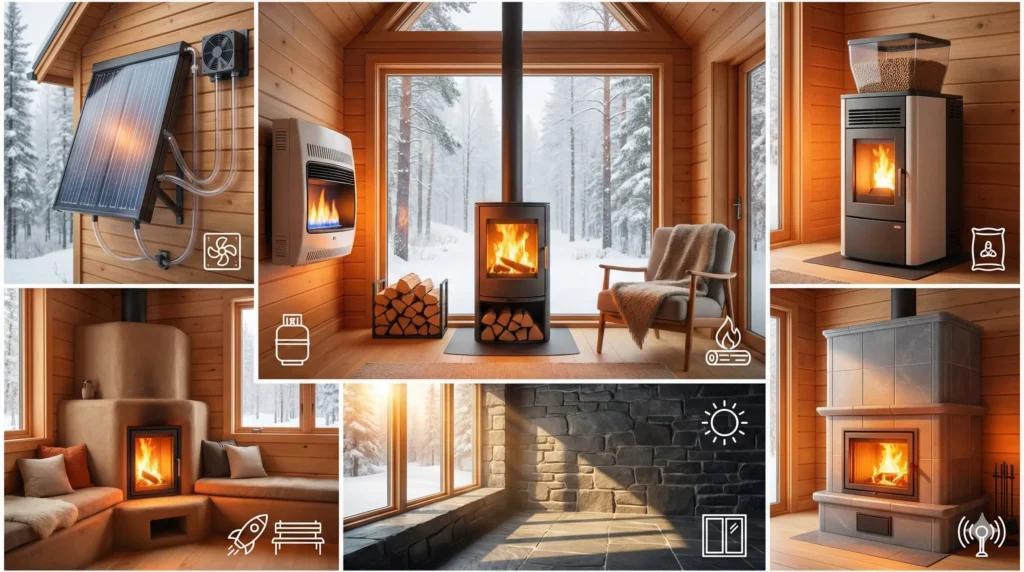
This guide compares 7 proven off-grid heating solutions based on real-world testing, BTU output, fuel costs, installation complexity, and maintenance requirements. Whether you’re heating a 200 sq ft cabin or a 2,000 sq ft home, you’ll find a system that matches your needs, budget, and climate.
Quick Comparison: Off-Grid Heating Methods
| Heating Method | Initial Cost | Fuel Cost/Year | BTU Output | Best For |
|---|---|---|---|---|
| Wood Stove | $800-2,500 | $200-600 (wood) | 30,000-80,000 | Forested areas, free wood access |
| Propane Heater | $200-1,200 | $600-1,500 | 10,000-30,000 | Backup heat, no chimney possible |
| Pellet Stove | $1,500-3,500 | $800-1,200 | 35,000-50,000 | Consistent heat, less maintenance |
| Passive Solar | $500-3,000 | $0 | Varies | Supplement, southern exposure |
| Rocket Mass Heater | $300-1,500 (DIY) | $100-300 | 20,000-40,000 | DIY builders, efficient wood use |
| Masonry Heater | $5,000-15,000 | $300-600 | 30,000-60,000 | Long-term investment, radiant heat |
| Solar Air Heater | $200-800 (DIY) | $0 | 5,000-15,000 | Daytime supplement, sunny climates |
Heating Method #1: Wood Stove – Most Popular Off-Grid Heat

Wood stoves remain the most common off-grid heating solution due to renewable fuel availability, high BTU output, and independence from commercial fuel sources. Modern EPA-certified stoves burn 50% more efficiently than older models, reducing wood consumption while increasing heat output.
How Wood Stoves Work
Wood combustion releases heat energy stored in cellulose. Modern wood stoves use secondary combustion chambers that burn smoke gases, extracting additional heat while reducing emissions. A properly sized stove can heat 800-2,000 square feet depending on insulation and climate.
Heat Output and Efficiency:
- Small stoves (30,000-40,000 BTU): Heat 400-800 sq ft
- Medium stoves (40,000-60,000 BTU): Heat 800-1,500 sq ft
- Large stoves (60,000-80,000 BTU): Heat 1,500-2,500 sq ft
- Burn time: 4-8 hours per load (overnight burns possible with hardwood)
Installation Requirements and Costs
Complete Installation Budget:
- EPA-certified wood stove: $800-2,500
- Chimney pipe (insulated): $400-1,200
- Hearth pad (fire protection): $150-400
- Installation labor (if hired): $500-1,500
- Total: $1,850-5,600
Essential Installation Components:
- DuraVent Double-Wall Chimney Pipe Kit – 6″ diameter, includes all fittings ($379)
→ View on Amazon
DIY installation reduces costs to $1,350-3,100 but requires understanding building codes, clearances, and chimney draft principles. Most jurisdictions require permits for wood stove installation.
Fuel Costs and Availability
Annual Wood Consumption (cold climate, 1,200 sq ft):
- 3-5 cords hardwood per heating season
- Purchased: $200-350 per cord = $600-1,750 annually
- Self-harvested: $0-200 (chainsaw fuel, maintenance)
- Wood must be seasoned 6-12 months before burning
Properties with forested acreage can harvest sustainably, making wood stove heating essentially free after initial investment. Urban and suburban users depend on purchased wood, increasing long-term costs.
Maintenance Requirements
Daily: Remove ash, reload wood 2-4 times
Weekly: Clean glass door, inspect door gasket
Monthly: Check chimney for creosote buildup
Annually: Professional chimney cleaning ($150-300), gasket replacement
Pros:
- ✅ Renewable fuel source (sustainable if forested)
- ✅ High heat output, warms large spaces effectively
- ✅ Cooking capability (flat top stoves)
- ✅ Aesthetic appeal, focal point for room
- ✅ No dependency on fuel delivery or power grid
Cons:
- ❌ Requires constant attention and reloading
- ❌ Wood processing is labor-intensive
- ❌ Creosote buildup creates fire hazard
- ❌ Heat distribution uneven
- ❌ Wood storage requires significant space
Recommended Wood Stoves:
- Drolet Escape 1800 Wood Stove – 65,000 BTU, EPA certified, heats up to 1,800 sq ft ($1,099)
→ View on Amazon - Vogelzang TR004 Colonial Wood Stove – 69,000 BTU, cast iron construction, heats 1,200 sq ft ($849)
→ View on Amazon
For powering fans or blowers to distribute wood stove heat, a small solar system can help. See our off-grid solar setup guide for sizing a system to run circulation fans.
Heating Method #2: Propane Heater – Convenient Backup Heat

Propane heaters offer instant heat without electricity, making them ideal for backup heating, spaces where wood stoves aren’t practical, or those unwilling to process firewood. Ventless models eliminate chimney requirements, simplifying installation.
Types of Propane Heaters
Ventless Wall-Mounted (10,000-30,000 BTU):
- Cost: $200-600
- No chimney required (oxygen depletion sensor included)
- Heats 400-1,000 sq ft
- 99% efficient (all heat stays indoors)
Vented Direct-Vent (20,000-40,000 BTU):
- Cost: $800-1,200
- Requires wall penetration for intake/exhaust
- Heats 800-1,500 sq ft
- Safer for continuous use (combustion gases vented outside)
Portable Propane Heater (4,000-18,000 BTU):
- Cost: $80-250
- 1 lb or 20 lb tank connection
- Heats 200-600 sq ft
- Emergency/temporary heating only
Propane Consumption and Costs
Fuel Usage (20,000 BTU heater running 8 hours daily):
- Propane consumption: ~0.9 gallons per day
- Monthly (30 days): 27 gallons
- Heating season (5 months): 135 gallons
- Cost: $2.50-4.00 per gallon = $338-540 per season
Propane prices vary regionally and by delivery quantity. Larger tanks (500-1,000 gallon) reduce per-gallon costs but require upfront investment ($1,200-2,500 installed).
Installation and Safety
Ventless propane heaters must be sized correctly for room volume. Oversized heaters deplete oxygen faster, triggering safety shutoffs. Most building codes limit ventless heater use to 40 BTU per square foot of space.
Safety Requirements:
- Oxygen depletion sensor (ODS) mandatory
- Carbon monoxide detector recommended
- Adequate room ventilation (crack window during use)
- Annual inspection of gas lines and connections
Pros:
- ✅ Instant heat, no warm-up time required
- ✅ Clean burning, minimal maintenance
- ✅ Thermostat control available
- ✅ No wood processing or ash removal
- ✅ Compact, suitable for small spaces
Cons:
- ❌ Ongoing fuel costs ($300-1,500 annually)
- ❌ Dependent on propane delivery
- ❌ Tank refills required every 2-6 months
- ❌ Ventless models create indoor humidity
- ❌ Not truly “off-grid” (relies on fuel supply)
Top-Rated Propane Heaters for Off-Grid Use:
- Mr. Heater Big Buddy – 18,000 BTU portable, indoor-safe with ODS, heats 450 sq ft ($179)
→ View on Amazon - Dyna-Glo Wall Heater – 30,000 BTU ventless, thermostat control, heats 1,000 sq ft ($289)
→ View on Amazon
Heating Method #3: Pellet Stove – Automated Wood Heating
Pellet stoves burn compressed wood pellets automatically fed from an internal hopper. This automation reduces labor while maintaining renewable biomass fuel. However, most pellet stoves require electricity for auger motors and fans, limiting true off-grid applicability.
Power Requirements for Off-Grid Use
Standard pellet stoves draw 100-300 watts during operation:
- Startup igniter: 300-400W for 10 minutes
- Auger motor: 50-100W (cycles on/off)
- Circulation fans: 50-150W continuous
- Control board: 5-10W
- Average consumption: 150W × 10 hours = 1.5 kWh daily
Running a pellet stove off-grid requires a solar system with battery backup. A 400W solar panel system with 200Ah battery capacity can power a pellet stove during winter months, though cloudy periods require careful energy management.
For sizing a solar system to run a pellet stove, use our off-grid solar calculator to determine panel and battery requirements based on your location.
Fuel Costs and Efficiency
Pellet Consumption (40,000 BTU stove, 1,200 sq ft):
- Average: 40-50 lbs pellets per day
- Heating season (150 days): 3-3.75 tons
- Pellet cost: $250-350 per ton
- Annual fuel cost: $750-1,300
Pellets are sold in 40 lb bags, requiring storage space and regular purchasing. Bulk delivery (by ton) reduces costs but requires covered storage and handling equipment.
Pros:
- ✅ Automated operation, minimal daily attention
- ✅ Cleaner burning than cordwood
- ✅ Thermostat controlled for consistent temperature
- ✅ Smaller footprint than wood stoves
- ✅ Renewable biomass fuel
Cons:
- ❌ Requires electricity (100-300W)
- ❌ Higher fuel costs than cordwood
- ❌ Dependent on pellet availability
- ❌ More complex mechanically
- ❌ Expensive repairs if components fail
Pellet Stoves Suitable for Solar-Powered Off-Grid:
- Castle Serenity Pellet Stove – 26,000 BTU, EPA certified, low power consumption (150W), heats 1,500 sq ft ($1,699)
→ View on Amazon
Ensure your off-grid power system can handle pellet stove loads. Our battery storage guide covers sizing backup power for heating equipment.
Heating Method #4: Passive Solar Design – Free Heat from the Sun
Passive solar heating captures sunlight through south-facing windows, storing heat in thermal mass (concrete, brick, water) for release after sunset. This method provides supplemental heat during sunny winter days, reducing reliance on active heating systems.
How Passive Solar Works
Winter sun enters through south-facing glazing at low angles, striking thermal mass that absorbs heat. As indoor temperatures drop at night, stored heat radiates from thermal mass, maintaining comfortable temperatures. Properly designed passive solar homes can obtain 50-70% of heating needs from the sun in sunny climates.
Key Design Elements:
- South-facing glass: Windows sized at 7-12% of floor area
- Thermal mass: 4-6 inches concrete, brick, or water storage
- Overhangs: Block summer sun, allow winter sun penetration
- Insulation: R-30 walls, R-50 ceiling minimum
- Night insulation: Window quilts/shutters prevent heat loss
Retrofit Options for Existing Structures
Adding passive solar to existing cabins or homes requires southern exposure and structural modifications:
Sunspace/Greenhouse Addition:
- Cost: $2,000-8,000 (DIY) or $8,000-20,000 (contractor)
- Attaches to south wall, captures solar heat
- Thermal mass inside stores heat for night release
- Can provide 20-40% of heating needs
Trombe Wall:
- Cost: $1,500-5,000 (DIY masonry)
- Glass-faced masonry wall on south side
- Sun heats dark masonry, warm air circulates through vents
- Provides steady heat 6-10 hours after sunset
Water Wall:
- Cost: $500-2,000 (55-gallon drums or tanks)
- Water containers behind south glazing
- Water stores 5x heat per volume vs concrete
- Simple, effective for small spaces
Performance and Limitations
Passive solar effectiveness depends heavily on climate, latitude, and consistent sunlight:
| Climate Zone | Winter Sun Hours | Passive Solar Contribution |
|---|---|---|
| Southwest (AZ, NM) | 7-9 hours daily | 50-70% of heating needs |
| Mountain West (CO, UT) | 6-8 hours daily | 40-60% of heating needs |
| Pacific Northwest | 3-5 hours daily | 20-35% of heating needs |
| Northeast, Midwest | 4-6 hours daily | 25-45% of heating needs |
Cloudy periods require backup heating. Passive solar works best as a supplement, not a sole heating source.
Pros:
- ✅ Zero fuel costs after installation
- ✅ No maintenance or moving parts
- ✅ Silent operation, no emissions
- ✅ Adds property value through energy efficiency
- ✅ Natural light improves living quality
Cons:
- ❌ Requires south-facing exposure without shading
- ❌ Expensive to retrofit existing structures
- ❌ Climate-dependent (ineffective in cloudy regions)
- ❌ Overheating risk in summer without proper overhangs
- ❌ Cannot be sole heating source in most climates
Heating Method #5: Rocket Mass Heater – Ultra-Efficient Wood Burning
Rocket mass heaters burn wood with exceptional efficiency (80-90% vs 60-75% for standard wood stoves) by using J-tube combustion chambers and thermal mass benches. Small amounts of wood produce sustained heat for 12-24 hours.
How Rocket Mass Heaters Work
Wood burns in an insulated vertical chamber, achieving complete combustion at high temperatures. Hot exhaust gases travel through horizontal masonry ducts (mass bench) before exiting, transferring heat to thermal mass. The mass radiates gentle heat long after fire extinguishes.
Typical System Components:
- Feed tube: Horizontal wood loading chamber
- Burn chamber: Insulated vertical combustion zone
- Heat riser: Creates draft, completes combustion
- Mass bench: Masonry thermal mass (3-8 tons)
- Exhaust: Chimney (can be minimal due to complete burn)
Wood Consumption and Efficiency
Fuel Requirements (vs Standard Wood Stove):
- Rocket mass heater: 1-3 armfuls of sticks daily (20-40 lbs)
- Standard wood stove: 3-6 armfuls daily (60-100 lbs)
- Wood savings: 50-70% reduction
One burn cycle (1-2 hours) heats thermal mass sufficiently for 12-24 hour heat release. Daily firing maintains consistent warmth without overnight loading.
DIY Construction and Costs
Material Costs (DIY Build):
- Metal barrel (heat riser): $20-80
- Stovepipe sections: $100-200
- Firebrick and insulation: $150-300
- Cob/masonry materials: $50-400 (depends on mass bench size)
- Miscellaneous hardware: $50-150
- Total DIY: $370-1,130
Professional installation is rare due to non-standard design. Most rocket mass heaters are owner-built following established plans. Construction takes 2-6 weeks depending on size and builder experience.
Pros:
- ✅ Exceptional efficiency (80-90% heat extraction)
- ✅ Burns small sticks and branches
- ✅ Gentle radiant heat from thermal mass bench
- ✅ Low wood consumption (50-70% less)
- ✅ Minimal creosote due to complete combustion
Cons:
- ❌ Building code approval difficult or impossible
- ❌ Large footprint (thermal mass bench takes space)
- ❌ DIY construction required (no commercial models)
- ❌ Heavy thermal mass limits placement options
- ❌ No insurance coverage (not UL certified)
Heating Method #6: Masonry Heater – Radiant Heat Storage
Masonry heaters burn wood at extremely high temperatures (1,800°F+) in refractory-lined fireboxes, channeling exhaust through internal masonry passages. Multi-ton mass stores heat, radiating warmth for 12-24 hours from a single hot fire.
Traditional vs Modern Masonry Heaters
Traditional European Designs:
- Finnish contraflow heaters (tulikivi)
- Russian/Siberian mass heaters
- German tiled stoves (kachelofen)
- Heritage designs with 200+ year proven performance
Modern Commercial Units:
- Factory-built cores with custom masonry facing
- Certified to meet EPA emissions standards
- Simplified installation vs full custom build
- Cost: $8,000-15,000 installed
Performance and Operation
Typical Firing Cycle:
- Load firebox with dry hardwood (20-40 lbs)
- Burn hot and fast for 1-2 hours
- Exhaust gases heat 4-8 tons of masonry
- Mass radiates gentle heat for 12-24 hours
- One or two fires daily maintain warmth
Unlike wood stoves requiring constant feeding, masonry heaters need brief hot fires. This complete combustion produces minimal emissions and ash while extracting maximum heat from wood.
Wood Consumption (1,500 sq ft, cold climate):
- 2-3 cords hardwood per season
- 40-60% less wood than standard wood stove
- Annual fuel cost: $400-1,050 (if purchasing wood)
Pros:
- ✅ Highly efficient (80-90% heat extraction)
- ✅ Gentle radiant heat (comfortable, not too hot)
- ✅ Low emissions (clean burn, minimal smoke)
- ✅ Long heat release (12-24 hours per firing)
- ✅ Reduced wood consumption vs standard stoves
Cons:
- ❌ Extremely expensive ($5,000-15,000 installed)
- ❌ Requires significant floor space and weight capacity
- ❌ Must be incorporated during construction
- ❌ Long initial warm-up period (2-3 days)
- ❌ Cannot rapidly increase heat output when needed
Heating Method #7: Solar Air Heater – DIY Supplemental Heat

Solar air heaters capture sunlight, warming air in insulated boxes that circulates into living spaces. Simple DIY designs cost $100-300 and provide 5,000-15,000 BTU on sunny days, reducing active heating system runtime.
DIY Solar Air Heater Construction
Basic Design Components:
- Glazing: Polycarbonate or glass front panel
- Absorber: Black-painted metal (aluminum cans, corrugated metal)
- Insulation: Rigid foam backing (R-10 minimum)
- Frame: Wood or aluminum box enclosure
- Vents: Bottom intake, top output (passive or fan-assisted)
Typical 4’×8′ Panel Performance:
- Output: 8,000-12,000 BTU on sunny day
- Temperature rise: 40-70°F above ambient
- Airflow: 100-200 CFM (passive) or 200-400 CFM (fan-assisted)
- Heating contribution: 15-30% reduction in backup system use
DIY Build Cost:
- Polycarbonate glazing (4’×8′): $80-120
- Aluminum cans or corrugated metal: $0-40 (scrap or recycled)
- Rigid foam insulation: $30-50
- Lumber for frame: $40-80
- Black paint, fasteners, caulk: $20-40
- Optional 12V fan + solar panel: $30-80
- Total: $200-410
Solar Air Heater Build Materials:
- Suntuf Polycarbonate Panels – 4’×8′ glazing, UV resistant, clear ($119)
→ View on Amazon - 12V Solar Panel Fan Kit – Direct solar powered, 20W panel + fan for air circulation ($49)
→ View on Amazon
Multiple panels can be installed on south-facing walls or roofs, scaled to heating needs. Construction takes 1-2 weekends with basic carpentry skills.
Integration with Off-Grid Power
Fan-assisted solar air heaters improve output 30-50% over passive designs. A small 10-20W solar panel can power the circulation fan directly during sunny hours when heating is needed—no battery required.
For integrated system design combining solar heating with solar power, see our guide on portable solar panels that can power small fans and pumps.
Pros:
- ✅ Very low cost ($200-400 DIY)
- ✅ Zero operating costs (no fuel, minimal electricity)
- ✅ Simple construction, easy to repair
- ✅ Reduces runtime of primary heating system
- ✅ Can be removed or relocated easily
Cons:
- ❌ Only works during sunny daylight hours
- ❌ No heat storage for nighttime
- ❌ Modest output (supplement only, not primary heat)
- ❌ Requires south-facing mounting location
- ❌ Effectiveness varies dramatically with weather
Choosing the Right Heating System for Your Situation
Selecting an off-grid heating method depends on climate, budget, fuel availability, and maintenance willingness. Most successful off-grid heating strategies combine multiple methods for redundancy and seasonal flexibility.
Recommended Combinations by Climate
Cold Climate (Northern States, High Elevation):
- Primary: Wood stove or masonry heater (40,000-60,000 BTU)
- Backup: Propane heater (20,000 BTU) for extended absences
- Supplement: Passive solar design if south exposure available
- Total investment: $2,500-8,000
Moderate Climate (Mid-Atlantic, Pacific Northwest):
- Primary: Propane or pellet stove (20,000-30,000 BTU)
- Supplement: Solar air heater (2-3 panels)
- Backup: Small wood stove for extended cold snaps
- Total investment: $1,800-5,000
Mild Climate (Southern States, Coastal Regions):
- Primary: Passive solar design + thermal mass
- Supplement: Solar air heaters
- Backup: Small propane heater for occasional cold nights
- Total investment: $1,200-4,000
Power Requirements for Heating Systems
Most off-grid heating methods require no electricity, but some components benefit from minimal power:
| Component | Power Draw | Daily Consumption |
|---|---|---|
| Wood stove circulation fan | 20-50W | 0.2-0.5 kWh |
| Pellet stove (complete system) | 100-300W | 1-3 kWh |
| Solar air heater fan | 10-30W | 0.05-0.15 kWh |
| Propane heater (electronic ignition) | 0-5W | 0-0.05 kWh |
Heat Distribution Fans for Wood Stoves:
- VIVOSUN 6 Inch Inline Duct Fan – 240 CFM, low noise, energy efficient for circulating wood stove heat ($29.99)
→ View on Amazon
A modest 400W solar system with 200Ah battery can power all these components comfortably. For detailed solar system sizing for heating equipment, consult our battery bank wiring guide.
Insulation: The Foundation of Efficient Heating
Before investing in heating systems, maximize insulation. Every dollar spent on insulation saves 3-5 dollars in heating equipment and fuel costs over system lifetime.
Minimum Insulation Standards for Off-Grid Homes
Cold Climate (Zone 6-7):
- Walls: R-30 minimum (2×6 studs + exterior foam)
- Ceiling/attic: R-50 minimum (16″ cellulose or fiberglass)
- Floor: R-30 minimum (especially over crawlspace)
- Windows: Triple-pane (R-5 minimum)
- Air sealing: 2 ACH50 or less (blower door test)
Moderate Climate (Zone 4-5):
- Walls: R-20 minimum
- Ceiling: R-38 minimum
- Floor: R-19 minimum
- Windows: Double-pane low-E (R-3)
High-Performance Insulation for Off-Grid Homes:
- Owens Corning R-30 Fiberglass Insulation – 88.1 sq ft coverage, for walls and ceilings ($59)
→ View on Amazon - Reflectix Double Bubble Insulation – Radiant barrier, R-3.7 to R-21, 48″×25′ roll ($67)
→ View on Amazon
Under-insulated structures waste 30-50% of heating energy. Upgrading insulation before installing heating systems reduces equipment size requirements and fuel consumption.
Maintenance and Safety Considerations
All heating systems require regular maintenance to operate safely and efficiently:
Annual Maintenance Checklist
Wood/Pellet Stoves:
- Chimney cleaning and inspection ($150-300 professional)
- Door gasket replacement if damaged ($20-40)
- Ash removal and firebox inspection
- Check for cracks in firebox or baffle plates
Propane Systems:
- Gas line leak testing (soapy water test, annual)
- Burner cleaning and inspection
- Oxygen depletion sensor function test
- Regulator and connection inspection
Solar Systems:
- Glazing cleaning (quarterly for solar air heaters)
- Seal inspection (caulk joints as needed)
- Fan cleaning and lubrication
- Check for condensation or moisture intrusion
Carbon Monoxide Safety
Any combustion heating system produces carbon monoxide. Install CO detectors even with properly vented systems:
- Place detectors 15 feet from heating appliances
- Install one per floor, one near sleeping areas
- Battery-powered models for off-grid use (test monthly)
- Replace detectors every 5-7 years
Battery-Powered CO Detectors for Off-Grid:
- Kidde Battery-Operated CO Detector – 10-year sealed battery, digital display ($39)
→ View on Amazon
Symptoms of CO poisoning include headache, dizziness, nausea, and confusion. If detector alarms, evacuate immediately and don’t return until the source is identified and repaired.
Real-World Cost Comparison: 10-Year Analysis
Total cost of ownership includes installation, fuel, maintenance, and repairs over 10 years:
| System | Install | Fuel (10yr) | Maintenance | Total |
|---|---|---|---|---|
| Wood Stove | $2,500 | $4,000 | $2,000 | $8,500 |
| Propane Heater | $800 | $8,000 | $500 | $9,300 |
| Pellet Stove | $3,000 | $10,000 | $1,500 | $14,500 |
| Passive Solar | $5,000 | $0 | $200 | $5,200 |
| Rocket Mass | $800 | $2,000 | $300 | $3,100 |
Assumes 1,200 sq ft, cold climate, purchased fuel at market rates. Self-harvested wood or solar supplement reduces costs significantly.
Frequently Asked Questions
What is the cheapest way to heat off-grid?
Rocket mass heaters offer the lowest total cost ($3,100 over 10 years) due to minimal fuel consumption and DIY construction. However, building code approval is challenging. For conventional systems, wood stoves with self-harvested firewood provide the most affordable heating at approximately $5,500 over 10 years including installation and maintenance.
Can I heat my off-grid home without cutting wood?
Yes. Propane heaters, pellet stoves, passive solar design, and solar air heaters don’t require wood processing. Propane is the most common alternative for those unwilling or unable to process firewood, though it requires ongoing fuel purchases and delivery logistics. Combining passive solar with a propane backup provides heat without wood processing labor.
How much wood do I need to heat a cabin for winter?
Wood consumption depends on cabin size, insulation, and climate. Average requirements: Small cabin (400-600 sq ft): 1-2 cords. Medium cabin (800-1,200 sq ft): 3-5 cords. Large home (1,500-2,000 sq ft): 5-8 cords. Well-insulated structures use 30-40% less wood. A cord of seasoned hardwood weighs approximately 3,000-4,000 lbs and costs $200-350 when purchased.
Do I need electricity to run an off-grid heating system?
Most off-grid heating methods require no electricity. Wood stoves, propane heaters, passive solar, and rocket mass heaters operate without power. Pellet stoves require 100-300 watts for augers and fans, manageable with a small solar system. Optional circulation fans for wood stoves improve heat distribution but aren’t essential. For detailed power requirements, see our solar system sizing calculator.
What’s the most efficient off-grid heating system?
Rocket mass heaters and masonry heaters achieve 80-90% efficiency, highest among combustion systems. Passive solar with adequate thermal mass can provide 50-70% of heating needs in sunny climates with zero fuel consumption, making it most efficient in appropriate locations. For fuel-based systems, rocket mass heaters use 50-70% less wood than standard stoves while providing equivalent heat output.
How do I prevent freezing when I’m away from my off-grid property?
Install a thermostat-controlled propane heater as backup heat, set to 40-45°F to prevent pipe freezing. Winterize water systems by draining pipes and adding antifreeze to P-traps. For extended absences, consider pipe heat tape powered by solar batteries, or install passive freeze protection using heat-conserving insulation around plumbing. Never rely solely on wood stoves when absent—they require constant feeding.
Can I combine different heating methods?
Yes, and it’s recommended for reliability. Common combinations include: Wood stove (primary) + propane heater (backup), Passive solar (supplement) + wood stove (main heat), Pellet stove (primary) + propane (backup when away). Multiple heating methods provide redundancy when primary system fails, fuel runs out, or you’re away from property. For complete off-grid system integration, review our off-grid living guide.
Conclusion: Building Your Off-Grid Heating Strategy
Successful off-grid heating requires matching systems to your specific situation—climate, budget, available fuels, and willingness to perform maintenance. No single “best” solution exists; rather, the right combination addresses your unique needs.
Key Takeaways:
- Wood stoves remain most popular due to renewable fuel and high output
- Propane provides convenient backup heat without wood processing
- Passive solar offers free heating where sun exposure permits
- Rocket mass heaters maximize wood efficiency for those comfortable with DIY
- Multiple systems provide redundancy and seasonal flexibility
Start by maximizing insulation—every heating system performs better and costs less to operate in a well-insulated structure. Then select primary and backup heating methods based on local fuel availability, installation constraints, and long-term cost analysis.
For those integrating heating with off-grid power systems, ensure your solar array and battery capacity can support any electrical loads from pellet stoves or circulation fans. Our resources on battery storage and inverter sizing provide detailed guidance on power system integration.
Whatever heating strategy you choose, plan for redundancy. Fuel shortages, equipment failures, and unexpected weather events all threaten single-system reliance. A well-designed off-grid heating plan keeps you warm through any circumstance while minimizing costs and maximizing energy independence.

Lio Verdan writes about solar energy, off-grid living, and eco-innovation through Gridova Living — a platform dedicated to energy freedom and sustainable technology.
