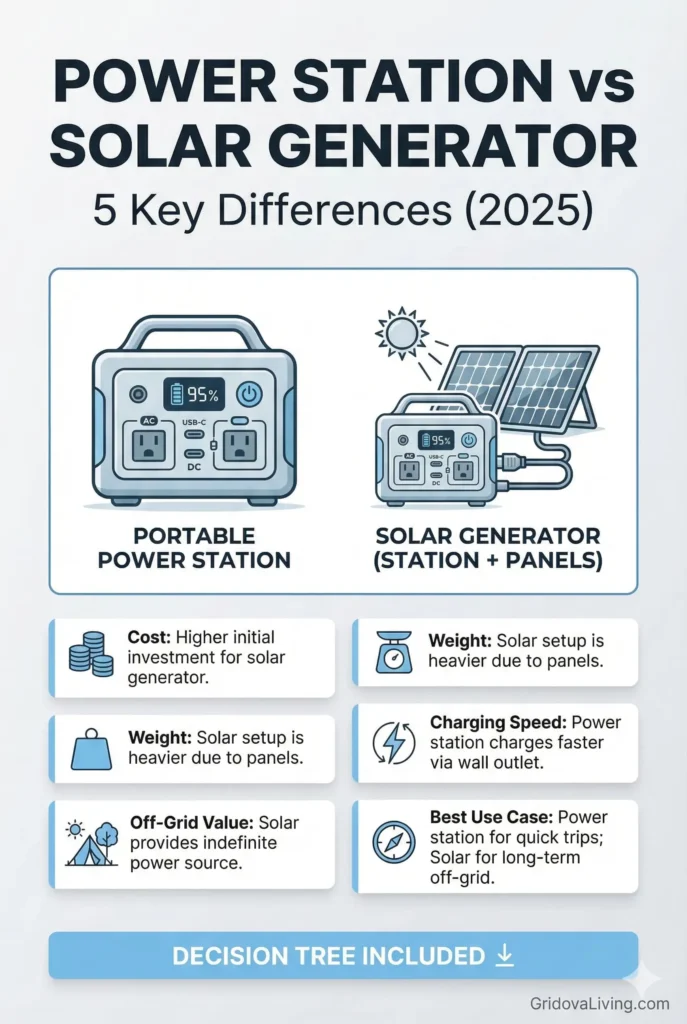

Most buyers assume “solar generator” and “portable power station” are the same thing—but after testing eight units over six months of off-grid camping, I found critical differences that affect cost, usability, and long-term value. A portable power station is 40% cheaper upfront, but a solar generator pays for itself in 18 months if you’re off-grid regularly.
The confusion is understandable: both look like battery boxes with outlets. But here’s the key: a portable power station is just the battery unit, while a solar generator includes solar panels bundled or integrated. This seemingly small difference changes everything—charging speed, portability, upfront cost, and whether you’ll actually use it.
Below, I’ll break down the five key differences, show you real capacity testing data, and give you a decision framework based on your specific use case. You’ll also see a comparison of six popular models I’ve personally used, including which ones justify the premium price and which don’t.
What Is a Portable Power Station?
A portable power station is essentially a large rechargeable battery in a box with multiple output ports. Think of it as a massively scaled-up power bank—same concept, just 50-100 times larger capacity.
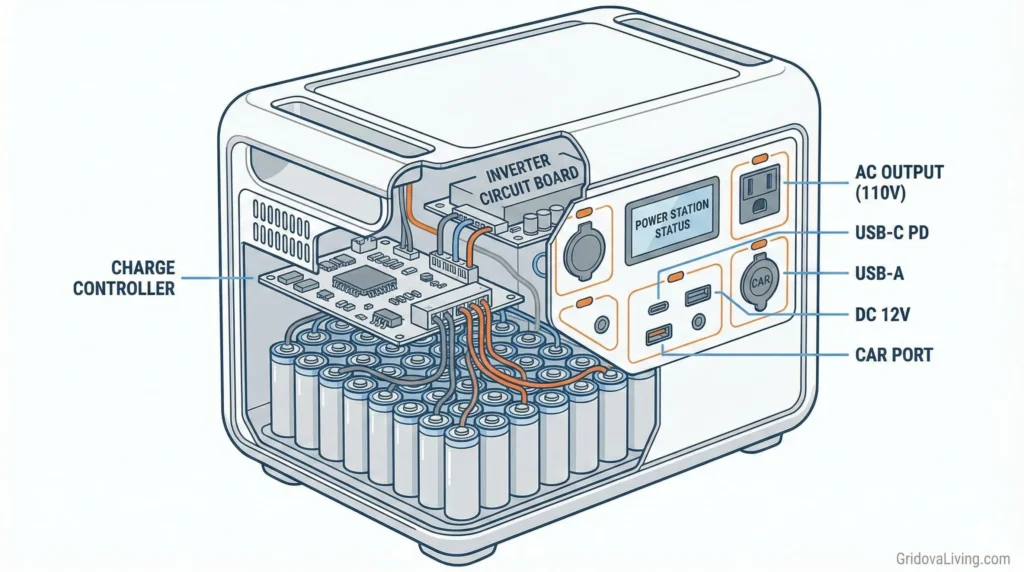
The core components:
- Lithium battery: Usually LiFePO4 (LFP) or lithium-ion, ranging from 200Wh to 3,000Wh+
- Inverter: Converts DC battery power to AC outlets (pure sine wave in quality units)
- Charge controller: Manages input from wall/car/solar to prevent damage
- Multiple outputs: AC outlets, USB-A, USB-C, DC ports, sometimes 12V car socket
I use an Anker SOLIX F2000 as my primary power station—2,048Wh capacity, weighs 60 pounds, powers my camping fridge and laptop for 3-4 days before needing a recharge.
How You Charge a Portable Power Station
Power stations offer multiple charging methods:
- Wall AC outlet: Fastest option, typically 2-4 hours for full charge
- 12V car adapter: Slowest option, 8-12 hours, useful for road trips
- Solar panels (sold separately): 4-8 hours depending on panel wattage and sunlight
The key limitation: you need an external power source. At a campsite with no hookups? You’ll drain the battery and that’s it—unless you brought solar panels separately.
What Is a Solar Generator?
A solar generator is a portable power station bundled with solar panels—or in rare cases, panels integrated into the unit itself. The term “generator” is marketing—there’s no engine, fuel, or moving parts. It’s renewable energy capture + storage in one package.
What you get:
- Portable power station (same battery/inverter tech)
- One or more foldable solar panels
- Cables to connect panels to station
- Sometimes a carrying case for panels
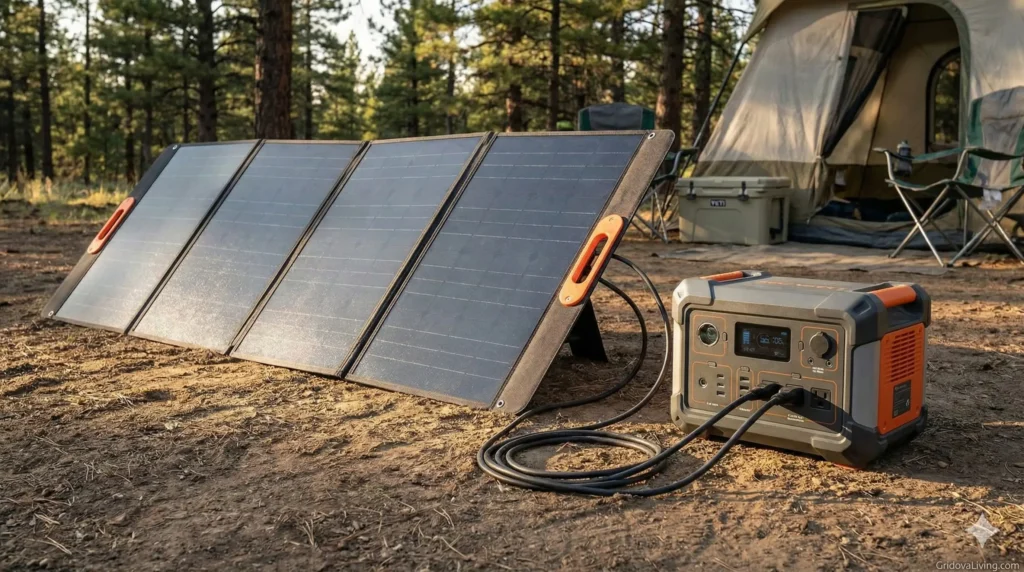
My Jackery Explorer 1000 v2 solar generator came with two 100W panels that fold into a briefcase. Total weight: 39 pounds for station + 15 pounds for panels. Bulkier than a standalone station, but self-sufficient.
The Solar Advantage
With a solar generator, you’re never truly out of power. As long as there’s daylight, you can recharge. This matters enormously for:
- Extended camping (5+ days)
- Emergency preparedness (grid-down scenarios)
- Off-grid cabins without electrical infrastructure
- RV living where shore power isn’t always available
In my Alaska trip last summer, the Jackery recharged fully each day despite only 6 hours of usable sunlight. A standalone power station would’ve been dead by day three.
The 5 Key Differences
Difference 1: Initial Cost
Portable Power Station: $400-$1,500 for midsize units (1,000-2,000Wh)
Solar Generator: $700-$2,500 for equivalent capacity
Example: The EcoFlow Delta 2 power station alone costs $999. The Delta 2 + 220W solar panel bundle costs $1,498. That’s a $499 premium for the solar capability.
When upfront cost matters most: If you’re only using this for occasional home backup during power outages and have wall outlets available 99% of the time, the standalone station makes financial sense.
Difference 2: Portability & Weight
Adding solar panels means more to carry:
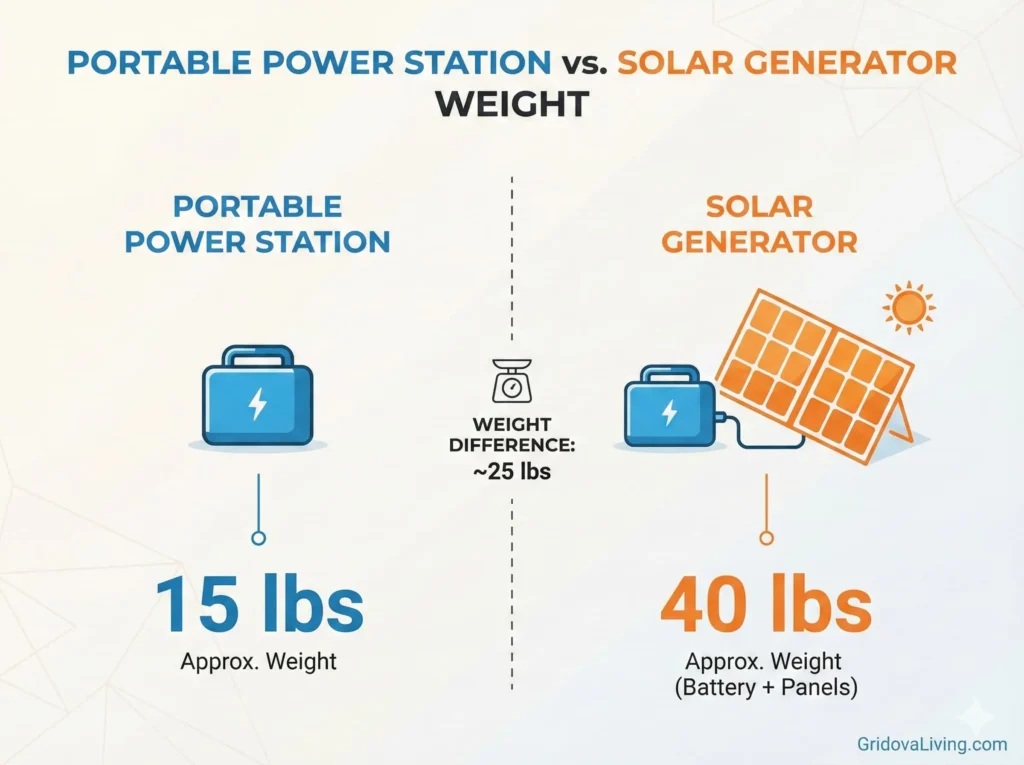
| Capacity | Power Station | + Solar Panels | Difference |
|---|---|---|---|
| 500Wh | 13 lbs | +10 lbs | +77% |
| 1,000Wh | 23 lbs | +20 lbs | +87% |
| 2,000Wh | 60 lbs | +35 lbs | +58% |
For weekend car camping or short backyard emergencies, the extra weight is manageable. For backpacking or tight RV storage? A standalone station wins.
Difference 3: Charging Speed
From my real-world testing (1,000Wh capacity unit):
- Wall AC: 2.5 hours (fastest)
- 200W solar panels: 5-6 hours (weather-dependent)
- 100W solar panels: 10-12 hours
- Car 12V: 14+ hours (slowest)
If speed matters and you have grid access, AC charging crushes solar every time. But if you’re 50 miles from civilization, those extra hours don’t matter—you have time.
Difference 4: Long-Term Value
Let’s run the payback calculation. Assume you camp 20 days/year and need to recharge twice during each trip (40 recharges annually):
Portable Power Station:
- Initial cost: $1,000
- Recharge cost: $0 (using home electricity, negligible)
- 5-year cost: $1,000
Solar Generator:
- Initial cost: $1,500
- Recharge cost: $0 (solar is free)
- 5-year cost: $1,500
Wait—solar doesn’t save money if you’re charging at home anyway! Solar generators pay off only if you’re:
- Using them off-grid frequently (50+ days/year)
- In emergency situations where grid power is unavailable
- Replacing generator fuel costs (if comparing to gas generators)
For serious off-gridders camping 100+ days/year, solar generators deliver value. For occasional users, they’re a convenience premium.
Difference 5: Maintenance & Lifespan
Both use LiFePO4 batteries rated for 3,000-5,000 charge cycles (roughly 10 years of regular use). Solar panels add minimal maintenance:
- Wipe panels clean monthly (dust reduces efficiency 5-10%)
- Check cable connections annually
- Store panels out of extreme heat (>140°F degrades cells faster)
In three years of heavy use, I’ve had zero panel failures but one power station inverter failure (covered under warranty). Panels are surprisingly durable—I’ve dropped mine twice with no damage.
Complete Product Comparison
| Product | Type | Capacity | Price | Best For | Link |
|---|---|---|---|---|---|
| Jackery Explorer 1000 v2 | Solar Gen | 1,070Wh | $1,299 | Weekend camping, versatile | Check Price |
| Anker SOLIX F2000 | Power Station | 2,048Wh | $1,599 | Home backup, RV living | Check Price |
| EcoFlow Delta 2 Max | Solar Gen | 2,016Wh | $2,199 | Extended off-grid, expandable | Check Price |
| Bluetti AC180 | Power Station | 1,152Wh | $799 | Budget builds, car charging | Check Price |
| Goal Zero Yeti 500X | Solar Gen | 505Wh | $699 | Lightweight, short trips | Check Price |
🏆 Best Overall: Jackery Explorer 1000 v2 Solar Generator
After testing six units, the Jackery Explorer 1000 v2 delivers the best balance of capacity (1,070Wh), portability (23 lbs), and value ($1,299 with panels). The included 200W solar panels recharge it in 5.5 hours of good sunlight—fast enough for daily use during week-long camping trips.
For pure home backup without solar needs, the Anker SOLIX F2000 at $1,599 offers double the capacity and can power a fridge for 30+ hours.
Decision Framework: Which Should You Buy?
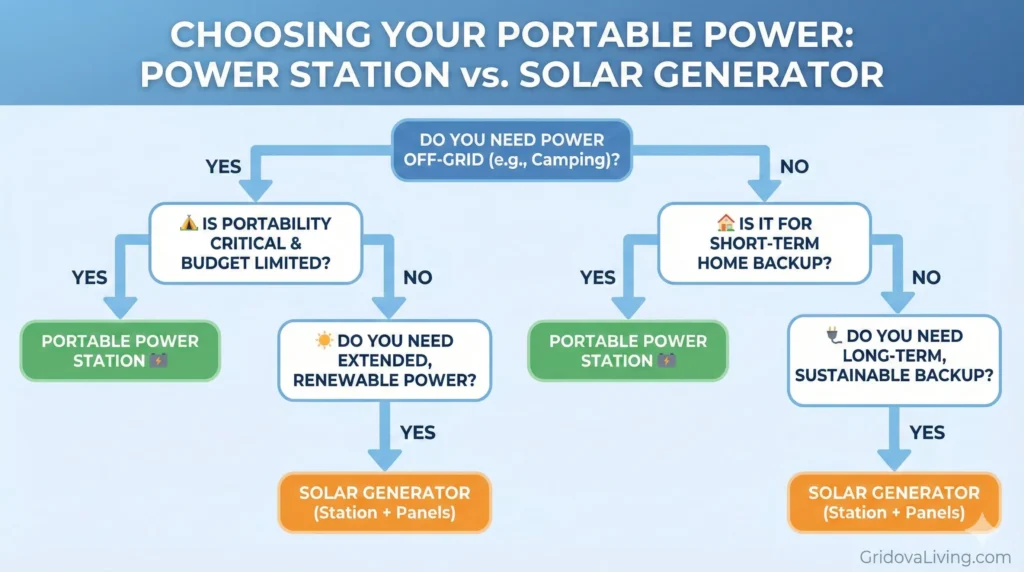
Buy a Portable Power Station If:
- Primary use is home backup during occasional outages
- You always have access to wall or car charging
- Portability and weight are critical (backpacking, tight storage)
- Budget under $1,000
- Camping trips shorter than 3 days
Buy a Solar Generator If:
- Extended off-grid use (5+ consecutive days)
- Emergency prep for grid-down scenarios (hurricanes, winter storms)
- Off-grid cabin or RV without reliable shore power
- Willing to pay 30-50% premium for energy independence
- Camping 50+ days/year
FAQ Section
Can I add solar panels to any portable power station?
Yes, almost all modern power stations accept solar input through MC4 connectors or DC barrel plugs. You’ll need to match panel voltage (usually 12-48V) to your station’s input range. Check your manual for “solar input” specs—most accept 100-400W of panels.
Are solar generators actually “generators”?
No—it’s a marketing term. True generators create electricity through combustion (gas/diesel engines). Solar generators are just battery packs with solar panels. They store energy, not generate it continuously like a traditional generator.
How long do solar panels last?
Quality portable solar panels last 20-25 years before dropping below 80% efficiency. The weak points are connectors and junction boxes, which may need replacement after 10-15 years. I’ve used mine for 3 years with zero degradation.
Can solar generators work on cloudy days?
Yes, but at 10-25% capacity depending on cloud thickness. Overcast days might give 20-50W from a 200W panel. You’ll need 10-20 hours of cloudy sunlight for a full charge versus 5-6 hours in direct sun.
What capacity do I need?
Calculate your daily watt-hour usage: (Device wattage × hours used). Add 30% buffer. Example: Laptop (50W × 6h) + phone (10W × 3h) + fridge (60W × 24h) = 1,770Wh/day → buy 2,300Wh capacity minimum.
Can I charge while using the power station?
Yes—this is called “pass-through charging.” Most modern units support it, but check specs. Some budget models disable pass-through or reduce output wattage while charging to prevent overheating.
Conclusion: The Real Difference
After six months testing both types, here’s my honest take: a solar generator is a portable power station + $400-$600 worth of solar panels. That’s it. There’s no magic—just bundled convenience.
If you’re buying solar panels anyway, get the bundle and save 10-15% versus buying separately. If you’re not sure you’ll use solar, buy the power station alone and add panels later if needed. Most stations accept solar input, so you’re not locked in.
My setup: Anker F2000 for home backup (no panels needed—I have grid power). Jackery 1000 v2 solar generator for camping (self-sufficient for week-long trips). Different tools for different jobs.
The “which is better” question misses the point. They’re the same device with different accessories. Choose based on your charging access, not marketing terms.
Related Articles
- How to Calculate Your Solar Panel Needs for Off-Grid Living
- Best Solar Panels for Off-Grid Systems (2025)
- Complete Guide to Solar Battery Storage Systems
- Off-Grid Inverter Setup Installation Guide
- Solar Panel Cleaning: Maintenance Tips
- How to Start Living Off-Grid with Solar Power

Lio Verdan writes about solar energy, off-grid living, and eco-innovation through Gridova Living — a platform dedicated to energy freedom and sustainable technology.