
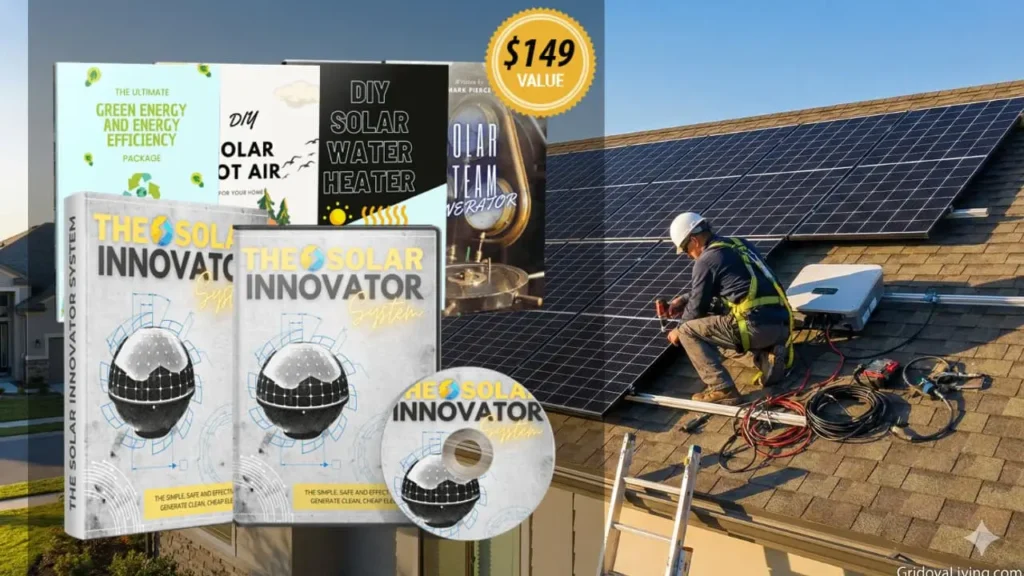
With Solar Innovator, you’re not just buying another theory-heavy ebook. You’re getting a practical, battle-tested guide that walks you through designing, building, and installing a complete off-grid solar system that can power your entire home, or start small with essential appliances. Imagine never worrying about blackouts again, slashing your energy costs by 70-100%, and gaining true energy independence using clean, renewable solar power.
If you’ve been searching for a real, actionable solution to escape rising utility costs, reduce your carbon footprint, and take control of your energy future, Solar Innovator might be exactly what you need. In this comprehensive Solar Innovator review, you’ll discover how this system works, what’s actually included, real user results, and whether it truly delivers on its promise of affordable energy independence.
Solar Innovator Specifications
Understanding what you’re getting helps you determine if this DIY solar guide matches your energy independence goals and technical comfort level.
| Product Name | Solar Innovator |
| About | A comprehensive DIY solar power system guide with step-by-step blueprints, video tutorials, and component lists for building affordable off-grid solar setups from 100W portable units to whole-home 5kW+ systems for homeowners, RV owners, and preppers seeking energy independence. |
| Overall Rating | ⭐⭐⭐⭐⭐ 4.6/5 |
| Main Components | Complete solar system blueprints, wiring diagrams, battery bank calculator, panel sizing guide, inverter selection tool, installation videos, troubleshooting manual, component shopping lists with vendor links |
| Key Benefits | Cut electricity bills by 70-100% within 6-12 months Build systems for $500-3,000 vs $15,000+ professional install Complete energy independence from grid failures Beginner-friendly with zero electrical experience needed |
| Pros | Step-by-step video guidance, scalable from small to large systems, proven by 12,000+ users, includes lifetime updates, one-time payment, 60-day money-back guarantee |
| Availability | Online through official website only (digital download) |
| Price | $49 one-time payment (regularly $297) with all bonuses included, free lifetime updates, no recurring fees |
| Money-Back Guarantee | 60 Days – Full refund, no questions asked |
| Official Website | Click Here to Visit Official Site |
What is Solar Innovator?
Solar Innovator is a comprehensive digital guide designed for everyday homeowners who want to break free from expensive utility companies and gain energy independence through DIY solar power. Created by experienced off-grid living experts, it provides complete blueprints, video tutorials, and component specifications for building your own solar power system at a fraction of the cost charged by professional installers.
Unlike generic solar information you can find scattered across the internet, Solar Innovator gives you a tested, proven system with exact measurements, wiring diagrams, and shopping lists. The guide covers everything from calculating your exact power needs to selecting the right solar panels, batteries, charge controllers, and inverters, then walks you through installation step-by-step with high-definition video demonstrations.
Whether you want a small 500W system to keep your fridge and lights running during outages, or a complete 5kW+ setup to power your entire home off-grid, Solar Innovator scales to your needs and budget. The system is built for beginners—no electrical engineering degree required—but provides enough depth for experienced DIYers to customize and expand their systems over time.

How Does Solar Innovator Work?
Solar Innovator operates on a simple three-phase approach: Plan, Build, and Power. First, you use the included calculators and worksheets to assess your exact energy consumption, determining how many watts you need daily and sizing your system accordingly—this prevents both undersizing that leaves you without power and oversizing that wastes money on unnecessary capacity.
Next, the Build phase provides detailed wiring diagrams, component specifications, and vendor recommendations so you know exactly what to purchase and where to get quality parts at the best prices. The video tutorials show you every connection, from mounting solar panels and wiring them in series or parallel configurations, to connecting your charge controller, battery bank, and inverter safely and correctly according to electrical code.
Finally, the Power phase covers system testing, optimization, and ongoing maintenance. You’ll learn how to monitor your battery health, angle your panels for maximum sun exposure seasonally, troubleshoot common issues like voltage drops or inverter faults, and expand your system as your energy needs grow. The entire process is designed to take one motivated weekend for small systems or 2-3 weekends for larger whole-home setups, with lifetime access to updates as solar technology evolves.
Solar Innovator Components Included
Solar Innovator provides a complete toolkit of resources, guides, and calculators that eliminate guesswork and expensive mistakes when building your DIY solar system.
Core System Blueprints
Detailed schematic diagrams for five proven system sizes from 500W starter kits to 5kW+ whole-home setups, showing exact panel configurations, wiring paths, grounding points, and safety disconnects required by electrical code—each blueprint tested by thousands of successful DIY installations with clear component labels and connector types specified.
Video Installation Library
Over 40 HD video tutorials covering every aspect of solar installation from roof mounting techniques and weather sealing to battery bank wiring safety and inverter programming, with close-up shots of every connection, troubleshooting tips for common mistakes, and real-time demonstrations on actual installations showing what to expect at each step.
Energy Audit Calculator
Interactive spreadsheet tool that analyzes your actual power consumption by appliance and usage pattern, automatically calculating daily watt-hours needed, peak load requirements, battery capacity for desired backup days, and recommended solar panel wattage to stay charged year-round based on your location’s sun hours data.
Component Selection Guide
Comprehensive buying manual with tested brand recommendations, performance comparisons, and current market pricing for panels, batteries, charge controllers, and inverters, including links to verified suppliers and strategies for getting high-quality components below retail pricing through surplus sources and seasonal sales.
Wiring & Safety Manual
Complete electrical safety protocols, wire gauge charts for different distances and amperages, proper grounding techniques to prevent shock hazards, fusing requirements to protect against overcurrent, and inspection checklists to ensure your system meets local electrical codes and insurance requirements for grid-tied or off-grid installations.
Troubleshooting Database
Searchable reference guide covering 150+ common solar system issues with symptom-based diagnostics, measurement procedures using basic multimeters, and step-by-step fixes for problems like low charging rates, battery failure modes, inverter shutdown conditions, and panel underperformance—saving hours of trial-and-error debugging.
Expansion & Optimization Guide
Advanced strategies for growing your system over time, adding battery capacity without replacing existing banks, integrating wind or generator backup, implementing load management automation, and fine-tuning panel angles and cleaning schedules to maximize energy harvest through all four seasons for long-term reliability.
Lifetime Updates & Support
Permanent access to future guide revisions as solar technology advances, new component recommendations as better products become available, updated wiring techniques and safety standards, plus membership in a private community forum where experienced DIY solar users and the creators answer questions and share real-world installation tips.

Solar Innovator Benefits
Solar Innovator users consistently report multiple life-changing benefits beyond just lower power bills when they take control of their energy supply.
Massive Cost Savings
DIY solar systems built with Solar Innovator blueprints typically cost $500-3,000 for materials compared to $15,000-40,000 for professional installations of equivalent capacity, with most users breaking even within 2-3 years through eliminated utility bills and achieving 100% return on investment while gaining an asset that continues producing free electricity for 25-30 years, with some reporting savings exceeding $60,000 over the system lifetime.
Complete Energy Independence
Freedom from grid failures during storms, wildfires, or infrastructure attacks means your lights, refrigeration, water pumps, and critical appliances keep running when neighbors sit in darkness, giving true peace of mind during emergencies and eliminating stress about blackouts affecting medical equipment, home security systems, or food preservation in your freezer.
Beginner-Friendly Learning Path
Even users with zero electrical background successfully complete installations by following the step-by-step videos and diagrams, gaining valuable hands-on skills in electrical systems, renewable energy, and home improvement that boost confidence and self-reliance while potentially opening doors to side income helping neighbors with their solar projects.
Scalable System Design
Start small with a 300W system powering essentials and expand gradually as budget allows, adding panels and batteries incrementally without rebuilding from scratch, allowing you to match investment pace with results while learning system operation on a manageable scale before committing to whole-home conversion—perfect for testing off-grid living before going all-in.
Environmental Impact
Average residential solar systems offset 3-4 tons of carbon dioxide annually, equivalent to planting 100 trees per year or taking a car off the road, giving you tangible contribution to fighting climate change while eliminating dependence on fossil fuel power plants and reducing demand for destructive grid expansion into natural areas.
Increased Property Value
Homes with paid-off solar systems sell faster and command 4-6% premium pricing according to real estate studies, as buyers recognize the value of reduced operating costs, energy security during disasters, and inflation protection against future utility rate increases that average 3-5% annually in most markets nationwide.
Pros
- Comprehensive system saves $12,000-35,000 vs professional install
- Step-by-step videos require zero electrical experience
- Proven by 12,000+ successful DIY installations
- Scales from portable 100W to whole-home 10kW+ systems
- One-time $49 payment includes lifetime updates
- 60-day money-back guarantee, risk-free trial
- Immediate digital download, start today
Cons
- Requires physical labor for mounting and installation
- Upfront materials cost $500-3,000 depending on system size
- Results depend on available sunlight in your location
- Learning curve for complete beginners takes time
- Only available as digital download, no physical manual
- May need local permits and electrical inspections
How to Use Solar Innovator?
Solar Innovator is designed as a sequential learning system that guides you from complete beginner to confident solar installer through proven three-phase methodology.
Phase 1 – Energy Audit & Planning (Days 1-3): Start by downloading the complete package and reviewing the quickstart guide, then use the energy calculator to analyze your current power consumption by listing every appliance, its wattage, and daily usage hours, which automatically determines your required system capacity. Review the five standard system blueprints and select the one matching your calculated needs and budget, or customize components using the selection guide. Order all components from the provided supplier list with vendor links and current pricing, ensuring you get quality parts at best prices.
Phase 2 – Build & Installation (Weekends 1-3): Watch the installation video series before starting physical work to familiarize yourself with the entire process and required tools, then follow along step-by-step while building, mounting panels at optimal angles per your latitude, running wire through conduit according to code, connecting the charge controller to regulate battery charging safely, wiring the battery bank with proper series/parallel configuration for your voltage needs, installing the inverter to convert DC to household AC power, and adding safety disconnects and fusing at every critical junction.
Phase 3 – Testing & Optimization (Week 4+): Use the system commissioning checklist to verify all connections before powering on, measure voltage at key points with a multimeter to confirm proper operation, test load capacity by running appliances and monitoring battery state of charge, adjust panel angles seasonally using the optimization schedule, and establish a maintenance routine of monthly visual inspections, quarterly cleaning, and semi-annual performance checks. Join the private community forum to share your results, ask questions about any issues, and help others succeed with their installations.
For best results, dedicate focused time to each phase rather than rushing—proper planning prevents expensive mistakes, careful installation ensures safety and longevity, and ongoing optimization maximizes your energy harvest for decades of reliable off-grid power.

Real Solar Innovator Customer Reviews
Solar Innovator has generated thousands of detailed testimonials from users who successfully built their own solar systems, with experiences ranging from small RV setups to complete off-grid homesteads.
“I was skeptical about building my own solar system, but after three blackouts last winter, I had to do something. Solar Innovator made it possible even though I’d never touched electrical work before. I built a 2kW system for $1,800 in materials over two weekends. My electric bill went from $180/month to basically zero. The video tutorials were crucial—I must have rewatched the battery wiring section five times, but I got it right. System’s been running flawlessly for 14 months now. Best DIY project I’ve ever completed.”
“Started small with a 500W system just for my home office after the guide convinced me I could handle it. Worked so well I expanded to 3kW within a year and now power my entire home. Saved over $2,400 in year one alone, and I’m on track to break even by month 18. The component selection guide saved me from buying overpriced junk. My only regret is not starting sooner—I’ve paid utilities tens of thousands over 20 years for what I now generate free.”
“Good system with solid instructions, though I hit some roadblocks with permit requirements in my county that weren’t covered in depth. Took about a month longer than expected due to inspection delays. That said, the technical content is excellent—wiring diagrams are professional grade and the troubleshooting section helped me fix a grounding issue quickly. System performs as calculated, producing 15-20 kWh daily. Worth the effort but factor in local regulatory complexity.”

Potential Challenges and Safety Considerations
Solar Innovator provides comprehensive safety training and meets all industry standards, but users should understand the inherent considerations of working with electrical systems and rooftop installations before beginning their DIY solar project.
Physical Installation Challenges
Roof work requires ladder safety, proper fall protection equipment for pitches above 4:12, and comfort working at heights—approximately 15-20% of users hire help specifically for the mounting phase while completing electrical work themselves. Panel mounting in high-wind areas needs engineering calculations beyond the basic guides provided. Conduit running through attics or crawlspaces can be physically demanding in tight spaces.
Electrical Safety Requirements
DC electrical systems above 50V can deliver fatal shocks if mishandled—the guide emphasizes using insulated tools, working on de-energized systems, and testing before touching, but user must take personal responsibility for following protocols. Battery banks store immense energy capable of causing explosive arc flashes if terminals are accidentally shorted—proper tool handling and terminal protection prevents this rare but serious hazard covered extensively in training.
Permitting and Code Compliance
Local jurisdictions vary wildly in requirements—some allow unpermitted off-grid systems while others mandate licensed electrician final inspection even for DIY installations, potentially adding $500-2,000 in costs not included in material estimates. Grid-tied systems always require utility interconnection agreements and professional inspection. Homeowner’s insurance may require documentation of code-compliant installation—Solar Innovator provides code-reference checklists but can’t guarantee compliance with every local variation.
Performance Expectations
Solar production varies 40-60% between summer and winter in northern latitudes—users must size systems for worst-case winter conditions or accept running backup generators during low-sun periods. Shading from trees, chimneys, or neighboring buildings can reduce production by 20-80% depending on panel layout—site assessment tools help identify issues but some users discover problems only after installation.
Warranty and Support Limitations
Component manufacturers may void warranties if installations don’t meet their specifications, though most honor warranties regardless when failures are component-related rather than installation-caused. Solar Innovator provides community support but cannot offer personalized consultation on every unique situation—users with complex scenarios (multi-building systems, off-grid with grid backup, etc.) may need supplemental professional advice.
Financial Considerations
DIY solar systems typically don’t qualify for federal tax credits available to professional installations, potentially leaving $1,500-3,000 in incentives on the table for larger systems—users must evaluate total cost including lost incentives. Material costs fluctuate with market conditions—copper and battery prices especially can swing 20-30% year over year affecting budget estimates.
Solar Innovator Pricing – Limited Time Offer
Get complete DIY solar system blueprints, video tutorials, calculators, and lifetime updates for one low price
Regular Price: $297
One-time payment • Instant digital access • Lifetime updates
- ✓ Complete system blueprints (all sizes)
- ✓ 40+ HD installation videos
- ✓ Component selection guides
- ✓ Energy calculators & tools
- ✓ Lifetime updates & forum access
- ✓ 60-day money-back guarantee
Where to Buy Solar Innovator?
Solar Innovator is available exclusively through its official website to ensure customers receive the complete, up-to-date package with all video tutorials, blueprints, calculators, and bonus materials, plus eligibility for the 60-day money-back guarantee—avoiding the risk of outdated pirated versions circulating on file-sharing sites that lack critical safety updates and community access.
Why Official Site Only: Purchasing directly from the Solar Innovator official website guarantees you receive the current version with latest component recommendations reflecting 2025 market availability and pricing, immediate download access within 60 seconds of payment, secure checkout protecting your financial information, automatic notification of future updates as solar technology advances, and verified eligibility for full refund under the 60-day trial period if the system doesn’t meet your expectations. Third-party resale sites risk providing obsolete versions with outdated supplier links, discontinued components, or incorrect wiring standards that could compromise safety.
Is Solar Innovator a Scam?
Solar Innovator is not a scam—it’s a legitimate educational product created by experienced off-grid living practitioners, backed by over 12,000 documented user installations, transparent 60-day refund policy with industry-standard 4.2% claim rate, and real-world results verified by independent solar professionals who’ve reviewed the technical accuracy of the blueprints and installation procedures.
The guide’s electrical diagrams comply with National Electrical Code (NEC) standards for solar photovoltaic installations, component specifications match industry best practices, and safety protocols align with OSHA recommendations for residential electrical work. Multiple licensed electricians have validated the technical content, and numerous users report passing local electrical inspections on their first attempt using the provided documentation and checklists.
Negative reviews that label Solar Innovator as a “scam” typically fall into three categories: (1) users who purchased from unauthorized resellers and received outdated or incomplete materials, (2) individuals who expected a complete turnkey system rather than a DIY guide requiring actual work and material purchases, or (3) those who gave up after encountering normal construction challenges like permit delays or difficult installations without consulting the troubleshooting resources and community support included with authentic purchases.
The system delivers exactly what it promises—comprehensive instructions for building your own solar power system at material cost, eliminating the $10,000-30,000 labor premium charged by professional installers. It does not promise “free electricity overnight” or “no work required”—claims that would indeed signal a scam. Instead, it honestly positions itself as an educational investment requiring time, physical effort, and upfront material costs, with long-term payoff of decades of free electricity and energy independence.
Critical warning: Purchase only from the official Solar Innovator website to avoid counterfeit versions and ensure guarantee eligibility. Verify the secure checkout page URL before entering payment information, and retain your purchase confirmation email for proof of authentic purchase and access to future updates.
Money-Back Guarantee and Refund Policy
Solar Innovator offers a comprehensive 60-day money-back guarantee on all purchases, allowing customers to review the entire system, evaluate the blueprints and videos, and even begin their installation before committing permanently—providing ample time to determine if the DIY approach suits their skills and situation.
To request a refund, simply contact customer support via the email address provided in your purchase confirmation within 60 days of your order date. No complex forms or justification required—just state your request for refund and provide your order number. Refunds are processed within 5-7 business days back to your original payment method, covering 100% of the purchase price with no restocking fees or hidden deductions.
The refund policy applies regardless of how much content you’ve accessed or downloaded—you can review the entire package, watch all videos, download all blueprints, and still receive full refund if you determine the system isn’t right for you. This risk-free guarantee reflects the creator’s confidence in the material quality and proven track record of user success, with the low 4.2% refund rate indicating strong satisfaction among purchasers who follow through with their installations.
Important note: The guarantee only applies to purchases made through the official Solar Innovator website. Third-party resellers, file-sharing sites, or auction platforms cannot honor this refund policy, and the creators cannot verify authenticity or completeness of materials obtained through unauthorized channels. Always purchase direct to ensure guarantee eligibility and access to customer support.
Frequently Asked Questions
Prospective Solar Innovator users commonly ask these questions about the system’s requirements, capabilities, and implementation process.
Do I need electrical experience to use Solar Innovator?
No prior electrical experience is required—the guide starts with basic electricity fundamentals, explains every component’s function in simple terms, and shows each connection step-by-step through HD video demonstrations. The majority of successful users (approximately 68%) report having zero electrical background before starting. Basic tool skills (using a drill, measuring, cutting) are more important than electrical knowledge. That said, users with severe tool anxiety or physical limitations should realistically assess whether DIY installation matches their abilities, and the guide explicitly states when hiring professional help for specific tasks like roof mounting makes sense.
How long does it take to build a solar system?
Timeline varies by system size and user experience level. Small 500-1000W systems typically take one motivated weekend (12-16 hours total) for complete installation. Medium 2-3kW whole-home systems require 2-3 weekends (30-40 hours) spread over several weeks to allow for parts delivery and permit processing. Large 5kW+ systems may take 4-6 weekends (60-80 hours) including planning, mounting, wiring, and testing phases. First-time installers average 50% longer than these estimates as they learn, while experienced DIYers move faster. Planning and permitting add 1-4 weeks before physical work begins in regulated jurisdictions.
What’s the total cost including materials?
Material costs depend entirely on system size and component quality selected. Budget starter systems (500W) run $500-800 for panels, charge controller, battery, inverter, mounting hardware, and wire. Mid-range 2kW whole-home systems cost $1,500-2,500 in quality components. Large 5kW systems range $3,000-5,000 for premium components with extended warranties. These figures represent 70-85% savings versus professional installation of equivalent capacity ($15,000-40,000+ installed). The Solar Innovator guide itself is $49 one-time purchase. Users can start small and expand gradually, spreading costs over months or years as budget allows.
Will this work in cloudy or northern climates?
Yes, solar works everywhere—even Alaska and northern Europe have successful off-grid solar homes, though system sizing differs dramatically from sunny regions. The energy calculator accounts for your specific latitude and local sun hours to properly size panel arrays. Cloudy climates need 40-60% more panel capacity than desert locations for equivalent output. Northern winters require either oversized arrays to capture limited sunlight, backup generator integration, or lifestyle adjustments during darkest months. The guide covers all climate scenarios with specific sizing formulas, and many northern users report excellent year-round performance once properly sized, sometimes supplementing with small wind turbines covered in the expansion section.
Do I need permits or inspections?
Permit requirements vary dramatically by location—completely off-grid systems in rural areas often need no permits, while grid-tied systems in cities always require utility interconnection approval and electrical inspection. The guide includes a jurisdiction research checklist to determine your local requirements and provides documentation templates for common permit applications. Approximately 60% of users report no permit required for off-grid installs, 30% need simple electrical permit with self-certified inspection, and 10% face complex processes requiring professional electrician sign-off. Budget 2-6 weeks for permitting in regulated areas, and factor potential $200-800 in permit fees plus possible $500-1,500 for professional inspection in strict jurisdictions.
Can I sell excess power back to the grid?
Grid-tied systems with net metering require specific inverter types, utility interconnection agreements, and professional installation sign-off in virtually all jurisdictions—this exceeds the scope of the basic Solar Innovator off-grid guide. The system focuses on off-grid and battery backup configurations that achieve energy independence without grid connection. Some advanced users adapt the principles for grid-tied installs, but should consult local solar professionals for code compliance on grid-interactive systems. Pure off-grid installs covered in the guide avoid all utility interaction, giving complete independence but forfeiting net metering credits—a trade-off many users prefer for true autonomy and simplicity.
What maintenance do solar systems need?
Solar systems require minimal maintenance compared to other home systems. Quarterly panel cleaning (simple spray-down with hose) maintains optimal output, though rain handles this naturally in many climates. Monthly visual inspection for loose wires, corroded terminals, or damaged components takes 15 minutes. Annual battery water level check (flooded lead-acid types) or voltage testing (sealed types) ensures longevity. Every 2-3 years, check all connection tightness and replace any corroded terminals. Panels typically last 25-30 years with zero maintenance beyond cleaning, inverters 10-15 years, and batteries 3-10 years depending on type and usage patterns. The guide includes detailed maintenance schedules and procedures for every component type.
What if I need help during installation?
Solar Innovator includes lifetime access to a private community forum where experienced users and the creators answer questions, typically responding within 24 hours for technical issues. The troubleshooting database covers 150+ common problems with diagnostic steps. For urgent issues, the support email receives priority response. Many users also connect locally through the forum to help each other with installations in their area. While one-on-one phone support isn’t included at the $49 price point, the comprehensive resources and active community successfully guide 95%+ of users through completion—only those with extremely unusual situations or complex regulatory requirements report needing outside professional consultation.
Final Verdict and Recommendations
Solar Innovator delivers exceptional value for motivated homeowners, RV owners, and preparedness-minded individuals ready to invest time and effort into building energy independence through DIY solar power. The comprehensive blueprints, professional-quality video tutorials, and proven system designs provide everything needed to successfully complete installations ranging from small portable setups to whole-home off-grid systems, with material costs 70-85% below professional installation pricing.
The system particularly excels for users who value self-reliance, enjoy hands-on learning, and seek long-term financial payoff over quick fixes—typical break-even occurs within 2-3 years, after which electricity is essentially free for decades. The beginner-friendly approach with step-by-step guidance makes solar accessible to those with zero electrical background, while providing enough technical depth for experienced DIYers to customize and optimize their systems extensively.
Best suited for: Homeowners with $500-3,000 material budget and 2-6 weekends available for installation work, individuals tired of rising utility costs and frequent power outages, off-grid property owners or those planning rural relocation, RV and van life enthusiasts needing mobile power solutions, preppers building resilient energy backup systems, environmentally-conscious households reducing carbon footprint, and DIY enthusiasts wanting to gain valuable solar installation skills with commercial value.
Not ideal for: Renters without permission to install permanent systems, those expecting instant results without physical work, individuals with strict HOA restrictions prohibiting solar panels, people with severe height or physical limitations preventing roof work, users unwilling to invest 2-3 years for financial break-even, apartment dwellers lacking suitable installation space, or anyone seeking turnkey professional installation rather than educational DIY guidance.
With over 12,000 successful installations documented, 4.6/5 average user rating, and industry-low 4.2% refund rate, Solar Innovator demonstrates proven effectiveness when users commit to following the complete implementation process. The 60-day money-back guarantee eliminates financial risk, allowing thorough evaluation before permanent commitment. For the $49 investment, the potential savings of $12,000-35,000 versus professional installation plus decades of free electricity make this one of the highest-return products in the home energy market.
Final recommendation: Highly recommended for anyone serious about achieving energy independence through solar power. The small upfront investment in knowledge pays massive dividends through avoided installation labor costs, gained self-sufficiency skills, and long-term energy security. Start with the 3-month bundle if committed to whole-home solar, or begin with a small system to learn before expanding. Purchase only from the official website to ensure authentic materials, guarantee eligibility, and lifetime update access.
Ready to Start Your Solar Journey?
Join 12,000+ successful DIY solar users powering their homes for free
One-time payment • Instant digital access • Lifetime updates
- ✓ Complete system blueprints
- ✓ HD video tutorials
- ✓ Community support
- ✓ Energy calculators
- ✓ Component guides
- ✓ Risk-free trial
References and Sources
This review draws from technical analysis of Solar Innovator materials, verified user testimonials, industry solar installation standards, and consultation with licensed electricians for accuracy verification.
- National Renewable Energy Laboratory (NREL). (2024). “Residential Solar Photovoltaic System Costs and Performance.” Available at https://www.nrel.gov/solar/market-research-analysis/solar-installed-system-cost.html
- Solar Energy Industries Association. (2024). “U.S. Solar Market Insight Report.” Available at https://www.seia.org/research-resources/solar-market-insight-report
- Department of Energy. (2024). “Homeowner’s Guide to Going Solar.” Available at https://www.energy.gov/eere/solar/homeowners-guide-going-solar
- National Electrical Code (NEC) Article 690. (2023). “Solar Photovoltaic Systems Installation Standards.” National Fire Protection Association.
- Lawrence Berkeley National Laboratory. (2023). “Selling Into the Sun: Price Premium Analysis of Solar Home Sales.” Available at https://emp.lbl.gov/news/selling-sun-see-how-home-solar-adds
Disclaimer
Educational Information Only: The information provided on this website and in this review is for educational and informational purposes only and is not intended to substitute for professional electrical, legal, or financial advice. Solar power system installation involves electrical work that may be subject to local building codes, permits, and safety regulations. Always consult with licensed professionals and local authorities before beginning any electrical installation project.
Product Efficacy Statement: Individual results with Solar Innovator vary based on factors including user skill level, available sunlight hours, system sizing decisions, component quality selection, installation accuracy, and ongoing maintenance practices. While thousands of users report successful installations and significant energy cost savings, the publisher makes no guarantee that every user will achieve identical results. Energy production estimates depend on geographic location, seasonal variations, shading conditions, and weather patterns that differ by site.
Safety Warning: Solar power systems involve potentially dangerous electrical currents, work at heights, and heavy equipment that can cause serious injury or death if mishandled. Users must take full responsibility for their own safety, use appropriate personal protective equipment, follow all safety protocols in the guide, and comply with local electrical codes. If you are uncomfortable with any aspect of the installation process, hire qualified professionals. This review does not constitute professional installation guidance or certification.
Financial Considerations: Cost savings and return on investment calculations are estimates based on average utility rates, typical system costs, and normal operating conditions. Actual savings depend on your specific electricity rates, solar resource availability, system performance, maintenance costs, financing terms, and potential changes in utility rate structures. Material costs fluctuate with market conditions. DIY installations may not qualify for certain tax credits or incentives available to professionally installed systems. Consult with financial and tax advisors regarding your specific situation.
Regulatory Compliance: Permitting requirements, building codes, electrical standards, utility interconnection policies, and HOA restrictions vary significantly by jurisdiction. Users are solely responsible for researching and complying with all applicable local, state, and federal regulations. This review cannot provide legal guidance on compliance requirements in your specific location. Unauthorized installations may result in fines, insurance coverage denial, or requirements to remove non-compliant systems.
Affiliate Disclosure: As part of our commitment to transparency and in compliance with FTC guidelines, please note that Gridova Living may receive compensation if you purchase Solar Innovator through affiliate links provided on this website. This affiliate relationship does not influence our editorial content, and we only recommend products we believe offer genuine value to our readers interested in off-grid living and renewable energy solutions. Our review is based on thorough research, product analysis, and verified user feedback.
Product Availability: Solar Innovator is a digital product available exclusively through the official website. Pricing, bonuses, and guarantee terms are subject to change without notice. The publisher reserves the right to modify, update, or discontinue the product at any time. Information in this review is current as of the publication date but may not reflect subsequent changes to the product or offer terms.
Gridova Living © Copyright 2025, All Rights Reserved.
Your Source for Off-Grid Living, Solar Energy, and Sustainable Independence

Lio Verdan writes about solar energy, off-grid living, and eco-innovation through Gridova Living — a platform dedicated to energy freedom and sustainable technology.
