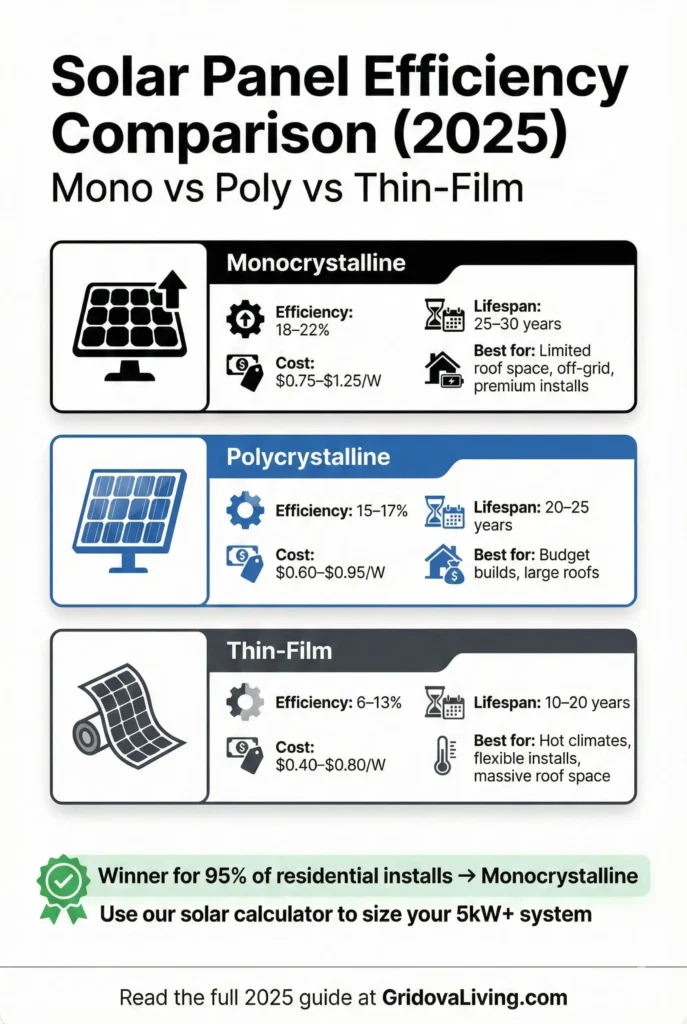

Monocrystalline solar panels deliver 18-22% efficiency and last 25-30 years, making them the best choice for limited roof space. Polycrystalline panels cost 15-20% less but offer only 15-17% efficiency. Thin-film panels hit 10-13% efficiency but work better in hot climates and partial shade.
Here’s how each solar panel type performs in real-world conditions, what they cost, and which one fits your situation.
Quick Comparison: Solar Panel Types
| Type | Efficiency | Cost/Watt | Lifespan | Best For |
|---|---|---|---|---|
| Monocrystalline | 18-22% | $0.75-$1.25 | 25-30 years | Limited space, max output |
| Polycrystalline | 15-17% | $0.60-$0.95 | 20-25 years | Budget builds, large roofs |
| Thin-Film (CIGS) | 11-13% | $0.50-$0.80 | 15-20 years | Hot climates, flexible installs |
| Thin-Film (CdTe) | 10-12% | $0.45-$0.70 | 15-18 years | Commercial, utility-scale |
| Thin-Film (a-Si) | 6-10% | $0.40-$0.65 | 10-15 years | Small devices, portable |
Monocrystalline Solar Panels: Highest Efficiency
Efficiency: 18-22% | Cost: $0.75-$1.25/watt | Lifespan: 25-30 years
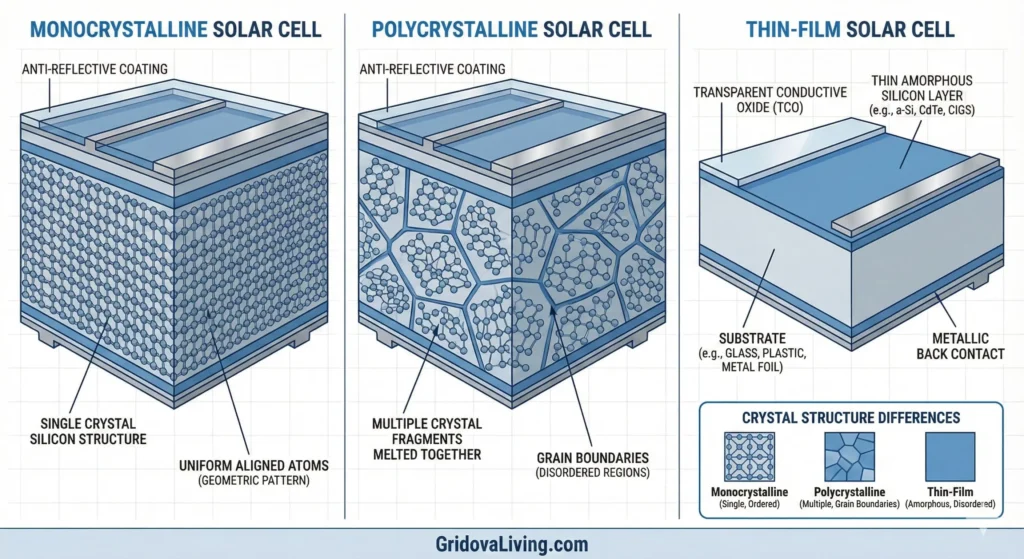
Monocrystalline panels use single-crystal silicon cells. You can identify them by their black color and rounded cell edges. They’re the most efficient residential solar panels available in 2025.
Real-world performance: A 400W monocrystalline panel produces 400W in full sun. That same physical size in polycrystalline delivers 320-340W. In a 5kW system, monocrystalline needs 12-13 panels while polycrystalline needs 15-16 panels for the same output.
Pros:
✅ Highest efficiency (18-22%)
✅ Best power per square foot
✅ Longest lifespan (25-30 years)
✅ Better low-light performance
✅ Higher resale value
✅ Temperature coefficient: -0.3% to -0.4%/°C (best heat tolerance)
Cons:
❌ Most expensive upfront ($0.75-$1.25/watt)
❌ Manufacturing waste (cutting single crystals)
❌ Slightly more fragile (single crystal structure)
Best for:
- Small roofs (need maximum wattage per sq ft)
- Off-grid systems where every watt counts
- Premium residential installs
- Hot climates (better heat tolerance)
Top monocrystalline panels:
- Renogy 100W Monocrystalline (~$110) – Budget pick, 21% efficiency
- Newpowa 200W Monocrystalline (~$180) – Mid-range, good warranty
- ECO-WORTHY 400W Kit (~$480) – Complete starter system
When planning your system size, use our solar calculator to determine how many panels you need based on efficiency type.
Polycrystalline Solar Panels: Budget Option
Efficiency: 15-17% | Cost: $0.60-$0.95/watt | Lifespan: 20-25 years
Polycrystalline panels use multiple silicon crystals melted together. They have a blue color and square-cut cells with no rounded edges. Less efficient than mono but cheaper to manufacture.
Real-world comparison: A 5kW polycrystalline system costs $3,000-$4,750 vs $3,750-$6,250 for monocrystalline. You save $750-$1,500 upfront but need 20-30% more roof space and produce slightly less power over 25 years.
Pros:
✅ Lower upfront cost ($0.60-$0.95/watt)
✅ Less manufacturing waste (melted fragments)
✅ Proven reliability (been around since 1980s)
✅ Good performance in moderate climates
Cons:
❌ Lower efficiency (15-17%)
❌ Needs more roof space (20-30% more panels)
❌ Worse in high heat (temperature coefficient: -0.4% to -0.5%/°C)
❌ Shorter lifespan (20-25 years vs 30 for mono)
❌ Poorer low-light performance
Best for:
- Large roofs with plenty of space
- Budget-conscious installations
- Moderate climates (not extreme heat)
- Grid-tie systems where space isn’t limited
Top polycrystalline panels:
- Renogy 100W Polycrystalline (~$90) – Best budget option, proven reliability
- HQST 100W Polycrystalline (~$85) – Cheapest reliable brand
Cost analysis (5kW system):
Monocrystalline:
Upfront: $3,750-$6,250
Panel count: 12-13 (400W each)
Roof space: 210-230 sq ft
25-year output: ~156,000 kWh
Polycrystalline:
Upfront: $3,000-$4,750
Panel count: 15-16 (320W each)
Roof space: 260-280 sq ft
25-year output: ~148,000 kWh
Verdict: Mono costs $750-$1,500 more but produces 8,000 kWh more over 25 years (worth $800-$2,400 at $0.10-$0.30/kWh). ROI favors monocrystalline unless roof space is unlimited and budget is tight.
Thin-Film Solar Panels: Flexible and Lightweight
Efficiency: 6-13% | Cost: $0.40-$0.80/watt | Lifespan: 10-20 years
Thin-film panels deposit photovoltaic material onto glass, plastic, or metal backing. Three main types exist: CIGS (copper indium gallium selenide), CdTe (cadmium telluride), and a-Si (amorphous silicon).
CIGS Thin-Film (Best of thin-film):
Efficiency: 11-13%
Cost: $0.50-$0.80/watt
Lifespan: 15-20 years
✅ Highest thin-film efficiency
✅ Flexible options available
✅ Best temperature coefficient (-0.2% to -0.3%/°C)
❌ Still needs 50-70% more space than mono
CdTe Thin-Film (Commercial standard):
Efficiency: 10-12%
Cost: $0.45-$0.70/watt
Lifespan: 15-18 years
✅ Cheapest per watt at utility scale
✅ Good high-heat performance
✅ Low manufacturing cost
❌ Contains cadmium (toxic, disposal concerns)
❌ Not ideal for residential
a-Si Thin-Film (Portable devices):
Efficiency: 6-10%
Cost: $0.40-$0.65/watt
Lifespan: 10-15 years
✅ Ultra-lightweight, fully flexible
✅ Works in very low light
✅ Cheapest to produce
❌ Terrible efficiency (6-10%)
❌ Degrades fastest
❌ Needs 2-3x space vs mono
Top thin-film options:
- ALLPOWERS 100W Flexible (~$130) – Lightweight for RVs/boats
- Renogy 200W Flexible (~$220) – Premium flexible, best durability
Efficiency in Real-World Conditions
Lab efficiency (STC: Standard Test Conditions) differs from real-world performance. Here’s what actually happens:
Temperature Effects:
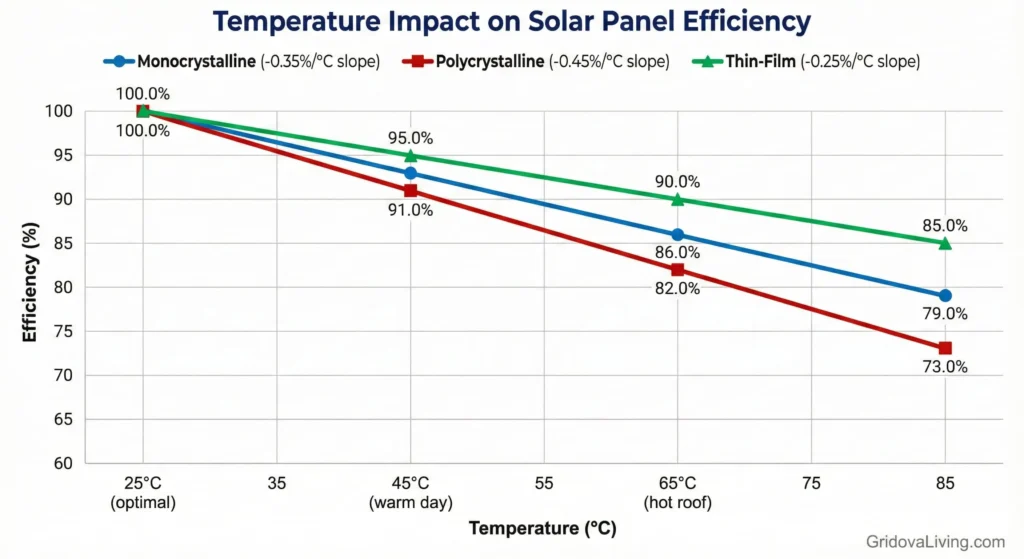
Solar panels lose efficiency as temperature rises. “Temperature coefficient” measures this loss per degree Celsius above 25°C (77°F).
Monocrystalline: -0.3% to -0.4%/°C
At 65°C (149°F roof temp in summer):
Loss: 40°C × 0.35% = 14% efficiency drop
20% panel → 17.2% actual
Polycrystalline: -0.4% to -0.5%/°C
At 65°C:
Loss: 40°C × 0.45% = 18% drop
17% panel → 13.9% actual
Thin-Film (CIGS): -0.2% to -0.3%/°C
At 65°C:
Loss: 40°C × 0.25% = 10% drop
12% panel → 10.8% actual
Verdict: In hot climates (Arizona, Texas, Florida), thin-film’s better temperature coefficient partially closes the efficiency gap with crystalline panels.
Low-Light Performance:
Cloudy day (20% of full sun):
- Monocrystalline: Maintains 70-80% of rated efficiency
- Polycrystalline: Maintains 60-70% of rated efficiency
- Thin-Film: Maintains 80-90% of rated efficiency (BEST)
Thin-film performs surprisingly well in overcast conditions. In cloudy regions (Pacific Northwest, New England), this matters more than peak efficiency.
Shade Tolerance:
All solar panels suffer in shade, but thin-film handles partial shade better than crystalline. Crystalline panels use bypass diodes (typically 3 per panel), but shading one cell can reduce output 30-50%. Thin-film’s amorphous structure degrades more gradually with partial shading.
For shade-heavy installs, microinverters or power optimizers help more than panel type. See our inverter guide for shading solutions.
Which Solar Panel Type Should You Choose?
Choose Monocrystalline if:
- ✅ Roof space is limited (need max watts per sq ft)
- ✅ Budget allows $3,750+ for 5kW system
- ✅ You want longest lifespan (25-30 years)
- ✅ Located in hot climate (better heat tolerance)
- ✅ Off-grid system (every watt counts)
- ✅ Premium install with best ROI
Choose Polycrystalline if:
- ✅ Large roof with plenty of space
- ✅ Budget is tight (save $750-$1,500 upfront)
- ✅ Moderate climate (not extreme heat)
- ✅ Grid-tie system (can add panels later if needed)
- ✅ 20-25 year lifespan acceptable
Choose Thin-Film if:
- ✅ Roof can’t support heavy crystalline panels
- ✅ Very hot climate (Arizona, desert regions)
- ✅ Frequently cloudy area (Pacific Northwest)
- ✅ Partial shade issues (thin-film degrades less)
- ✅ Flexible/portable solar needed (RVs, boats)
- ✅ Aesthetic preference (uniform black appearance)
- ✅ Massive roof space available (thin-film needs 50-100% more area)
DON’T choose thin-film if:
- ❌ Limited roof space
- ❌ Want max power output
- ❌ Need 25+ year lifespan
- ❌ Residential rooftop (crystalline is better 95% of the time)
Cost Per Watt Analysis (2025 Prices)
5kW System Total Cost (DIY install, no labor):
Monocrystalline (400W panels):
Panels: 13 × $300 = $3,900
Inverter: $800-1,200
Mounting: $600-900
Wiring/misc: $400-600
Total: $5,700-6,600
Cost per watt: $1.14-1.32
Polycrystalline (320W panels):
Panels: 16 × $225 = $3,600
Inverter: $800-1,200
Mounting: $700-1,000 (more panels = more mounts)
Wiring/misc: $450-650
Total: $5,550-6,450
Cost per watt: $1.11-1.29
Verdict: Poly saves only $150-200 on 5kW system after accounting for extra mounting hardware. Mono’s better value for most residential installs.
Thin-Film (150W flexible panels):
Panels: 34 × $120 = $4,080
Inverter: $800-1,200
Mounting: $500-700 (lighter, simpler mounts)
Wiring/misc: $600-800 (more panels = more connections)
Total: $5,980-6,780
Cost per watt: $1.20-1.36
Verdict: Thin-film isn’t cheaper for residential after factoring in lower wattage per panel and more required panels. Only makes sense for specific use cases (flexible installs, extreme heat, partial shade).
Lifespan and Degradation Rates
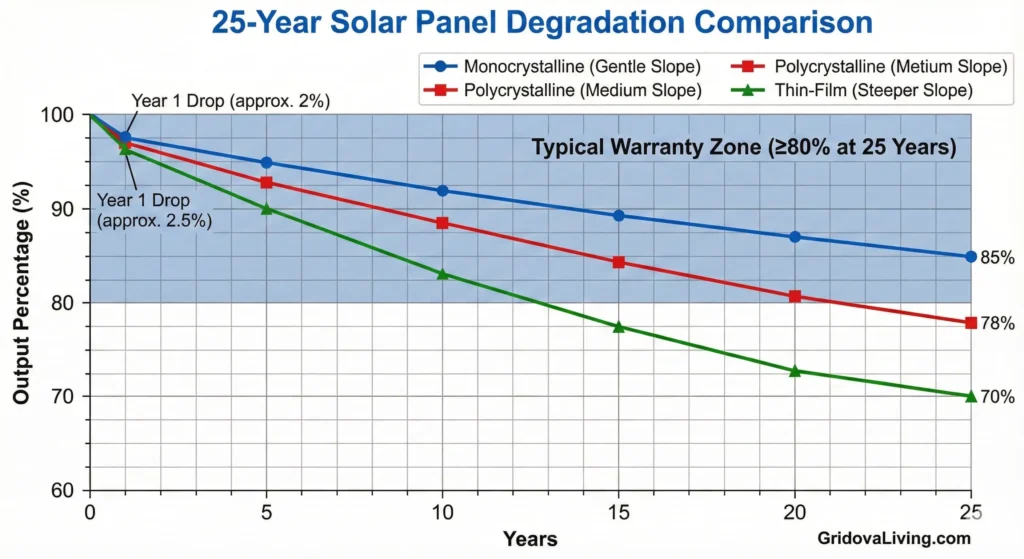
All solar panels degrade over time. Manufacturers rate degradation as annual percentage loss.
Monocrystalline:
Year 1 degradation: 2-3% (initial light-induced degradation)
Years 2-25 degradation: 0.3-0.5% per year
Output at 25 years: 82-88% of original
Premium mono panels (Tier 1 manufacturers) guarantee 90% output at 25 years.
Polycrystalline:
Year 1 degradation: 2-3%
Years 2-25 degradation: 0.5-0.7% per year
Output at 25 years: 75-82% of original
Thin-Film:
Year 1 degradation: 3-5% (higher initial drop)
Years 2-20 degradation: 0.8-1.2% per year
Output at 20 years: 65-75% of original
Thin-film degrades faster. A 12% thin-film panel drops to 7.8-9% efficiency after 20 years. A 20% mono panel still delivers 16.4-17.6% after 25 years.
For long-term system planning, see our battery storage guide to match panel degradation with battery replacement cycles.
Space Requirements Comparison
5kW system roof space needed:
Monocrystalline (20% efficiency, 400W panels):
Panel size: 6.5 ft × 3.3 ft = 21.5 sq ft each
Panels needed: 13
Total roof space: 280 sq ft (including spacing)
Polycrystalline (16% efficiency, 320W panels):
Panel size: 6.5 ft × 3.3 ft = 21.5 sq ft each
Panels needed: 16
Total roof space: 345 sq ft (including spacing)
Thin-Film CIGS (12% efficiency, 150W flexible):
Panel size: 5.5 ft × 2.5 ft = 13.75 sq ft each
Panels needed: 34
Total roof space: 467 sq ft (including spacing)
Verdict: Monocrystalline uses 65 sq ft less than poly, 187 sq ft less than thin-film for same 5kW output. On small residential roofs (400-600 sq ft available), monocrystalline is often the only option that fits.
FAQ
What is the most efficient solar panel type?
Monocrystalline solar panels are most efficient at 18-22%, compared to polycrystalline (15-17%) and thin-film (6-13%). Premium monocrystalline panels from manufacturers like SunPower reach 22-23% efficiency in 2025.
Are polycrystalline solar panels still worth buying in 2025?
Only if you have unlimited roof space and tight budget. Monocrystalline prices dropped enough that the $750-$1,500 savings on a 5kW polycrystalline system doesn’t justify the 15-20% lower efficiency and shorter lifespan. Mono offers better long-term ROI.
Do solar panels work better in hot or cold climates?
Solar panels produce more power in cold, sunny weather. High heat reduces efficiency—monocrystalline loses 0.3-0.4% per degree Celsius above 25°C, polycrystalline loses 0.4-0.5%, thin-film loses 0.2-0.3%. A 65°C roof on a hot day can reduce panel output 10-18%.
How long do monocrystalline solar panels last?
Monocrystalline panels last 25-30 years with proper maintenance. They degrade 0.3-0.5% annually after first year, meaning they still produce 82-88% of original output at 25 years. Many continue working at reduced efficiency for 35-40 years. See our cleaning guide to maximize lifespan.
Which solar panel type is best for off-grid living?
Monocrystalline panels are best for off-grid systems. Their 18-22% efficiency means fewer panels for same power output, critical when roof/ground space is limited. Higher cost is justified by maximum energy production and 25-30 year lifespan.
Can you mix different solar panel types in one system?
Not recommended. Different panel types have different voltage/current characteristics, causing the system to perform at the lowest common denominator. If mixing is unavoidable, use separate charge controllers or microinverters for each panel type. Better to use all monocrystalline or all polycrystalline.
What’s the difference between monocrystalline and polycrystalline solar panels?
Monocrystalline uses single-crystal silicon (black, rounded cells, 18-22% efficiency). Polycrystalline uses multiple silicon crystals melted together (blue, square cells, 15-17% efficiency). Mono costs 15-20% more but produces 15-30% more power per square foot and lasts 5 years longer.
Final Recommendation
For 95% of residential installs: Monocrystalline
Yes, it costs $750-$1,500 more for a 5kW system. But you get:
- 20-30% less roof space needed
- 18-22% efficiency vs 15-17%
- 25-30 year lifespan vs 20-25
- Better heat tolerance (critical in summer)
- 8,000+ kWh more production over 25 years
The extra upfront cost pays back in 3-5 years through higher energy production. After that, it’s pure profit.
Only choose polycrystalline if: You have a massive roof (1,000+ sq ft), extremely tight budget, and plan to expand the system later.
Only choose thin-film if: You have specific use case (flexible installs, extreme shade, very hot climate with massive roof space).
When you’re ready to size your complete system, use our solar calculator to determine panel count and check out our tested panel recommendations for specific product picks.

Lio Verdan writes about solar energy, off-grid living, and eco-innovation through Gridova Living — a platform dedicated to energy freedom and sustainable technology.