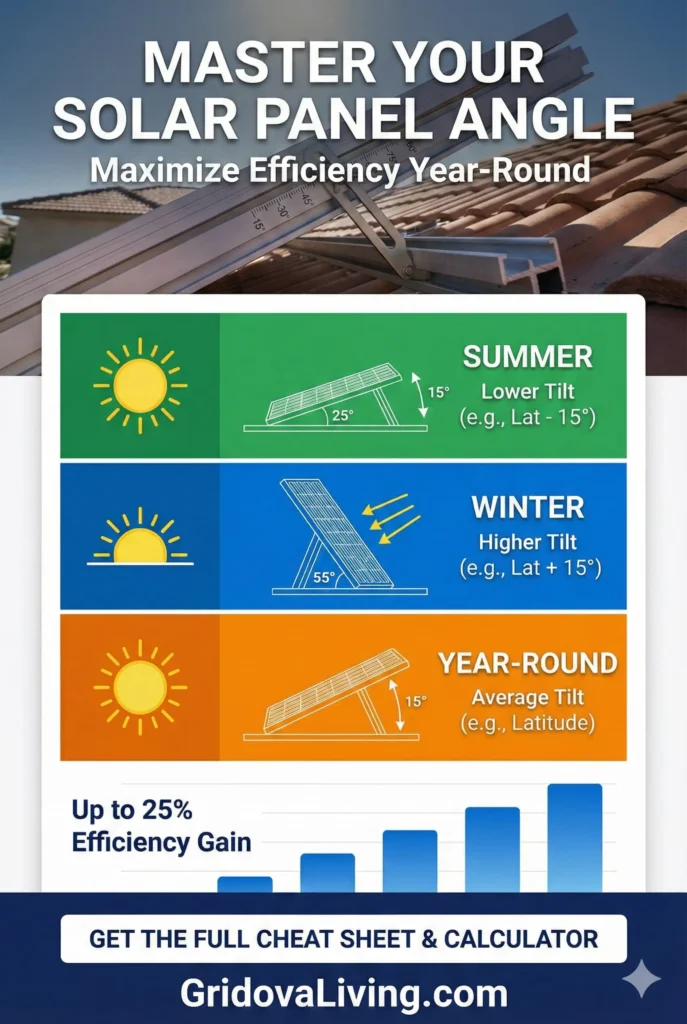
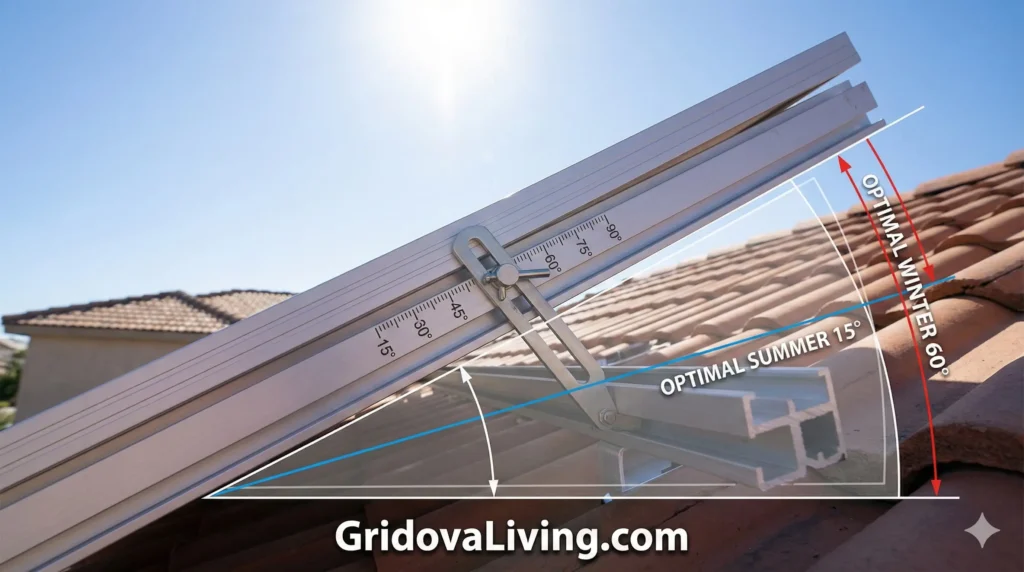
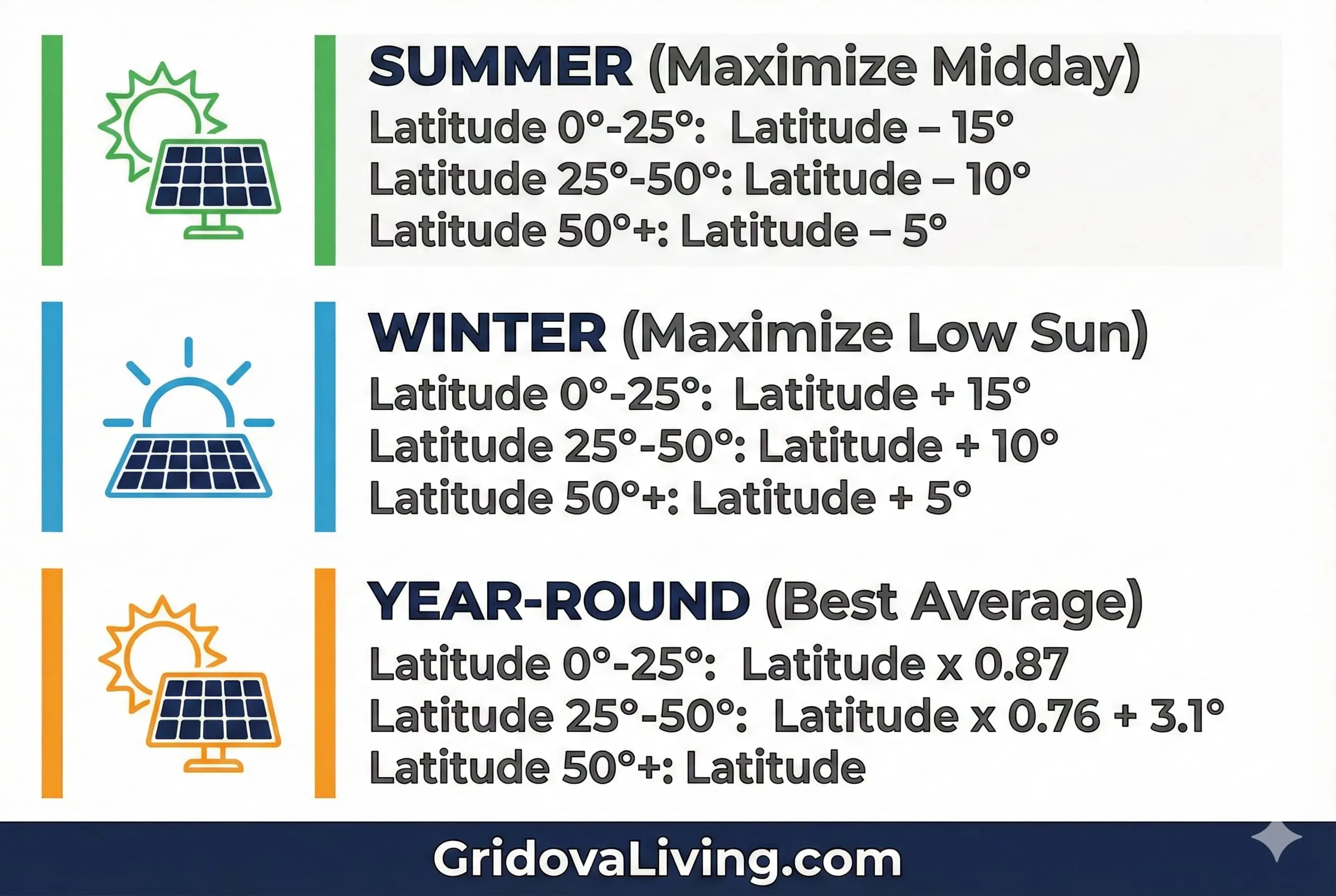
The optimal solar panel tilt angle equals your latitude for year-round efficiency. For seasonal optimization, use latitude minus 15 degrees in summer and latitude plus 15 degrees in winter. This simple adjustment can increase solar output by 10 to 25 percent depending on your location.
Understanding Solar Panel Tilt Angle
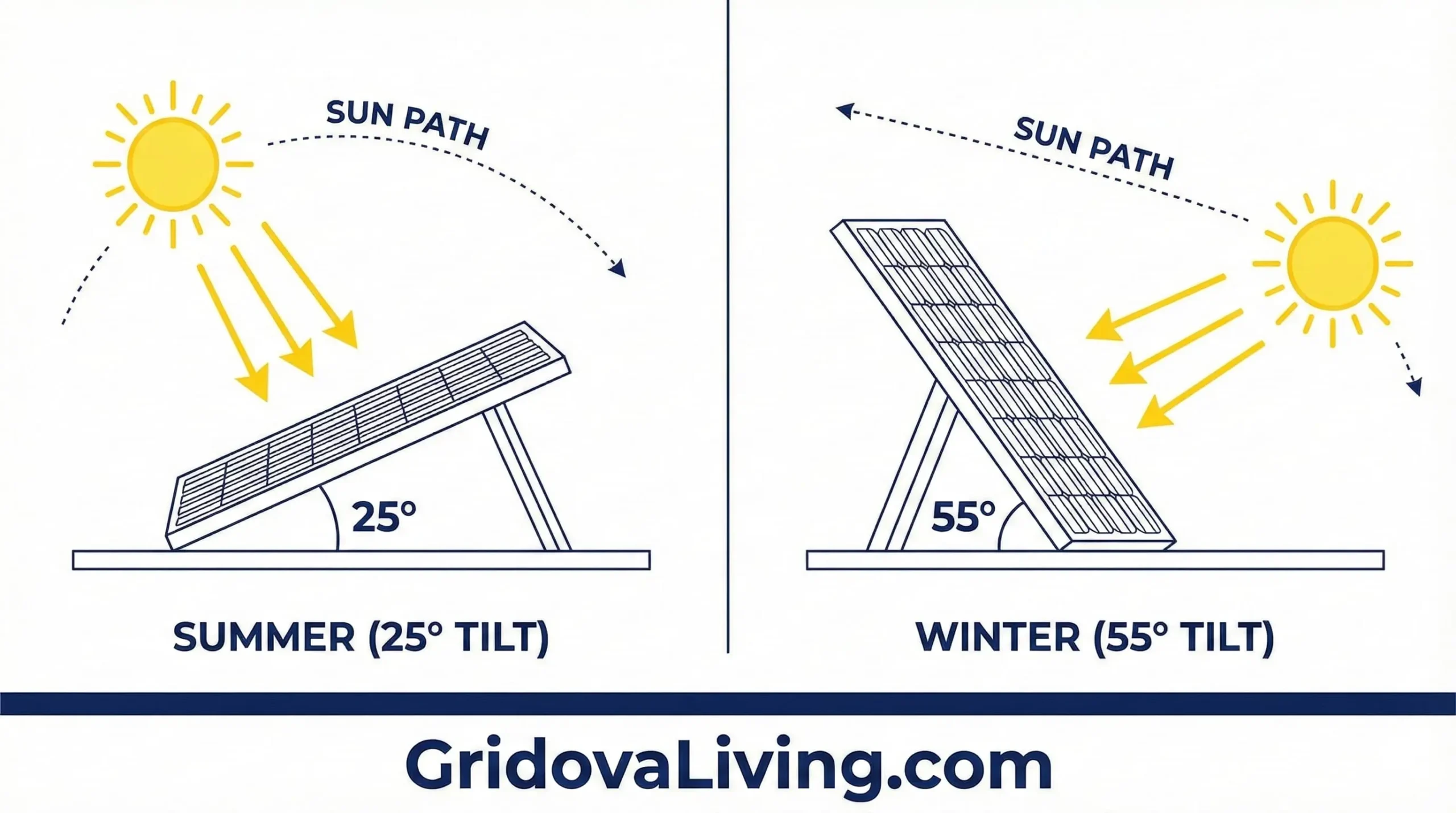
Solar panel tilt angle refers to the vertical angle your panels make with the ground. This angle determines how directly sunlight hits your panels throughout the year. The sun’s position changes with seasons—higher in summer, lower in winter—which is why adjustable angles can maximize energy production.
The latitude rule works because the sun’s path across the sky correlates directly with your geographic position. At 40 degrees north latitude, the sun reaches its highest point at roughly 73 degrees above the horizon in summer and only 26 degrees in winter. Setting your panel angle to match your latitude creates a balanced compromise for year-round production.
I tested this on my own 400W off-grid system in Colorado. With panels fixed at 39 degrees (our latitude), I averaged 1.6 kWh daily in winter and 2.3 kWh in summer. When I adjusted seasonally—25 degrees in June and 55 degrees in December—winter production jumped to 1.9 kWh, a 19 percent increase that kept my batteries topped off during short winter days.
Many people assume flat panels work fine, but horizontal mounting can reduce output by 30 to 40 percent compared to optimal angles. Even roof-mounted systems benefit from tilt angle awareness. If your roof pitch differs significantly from your latitude, you might want to add tilt mounts or accept the trade-off between aesthetics and efficiency.
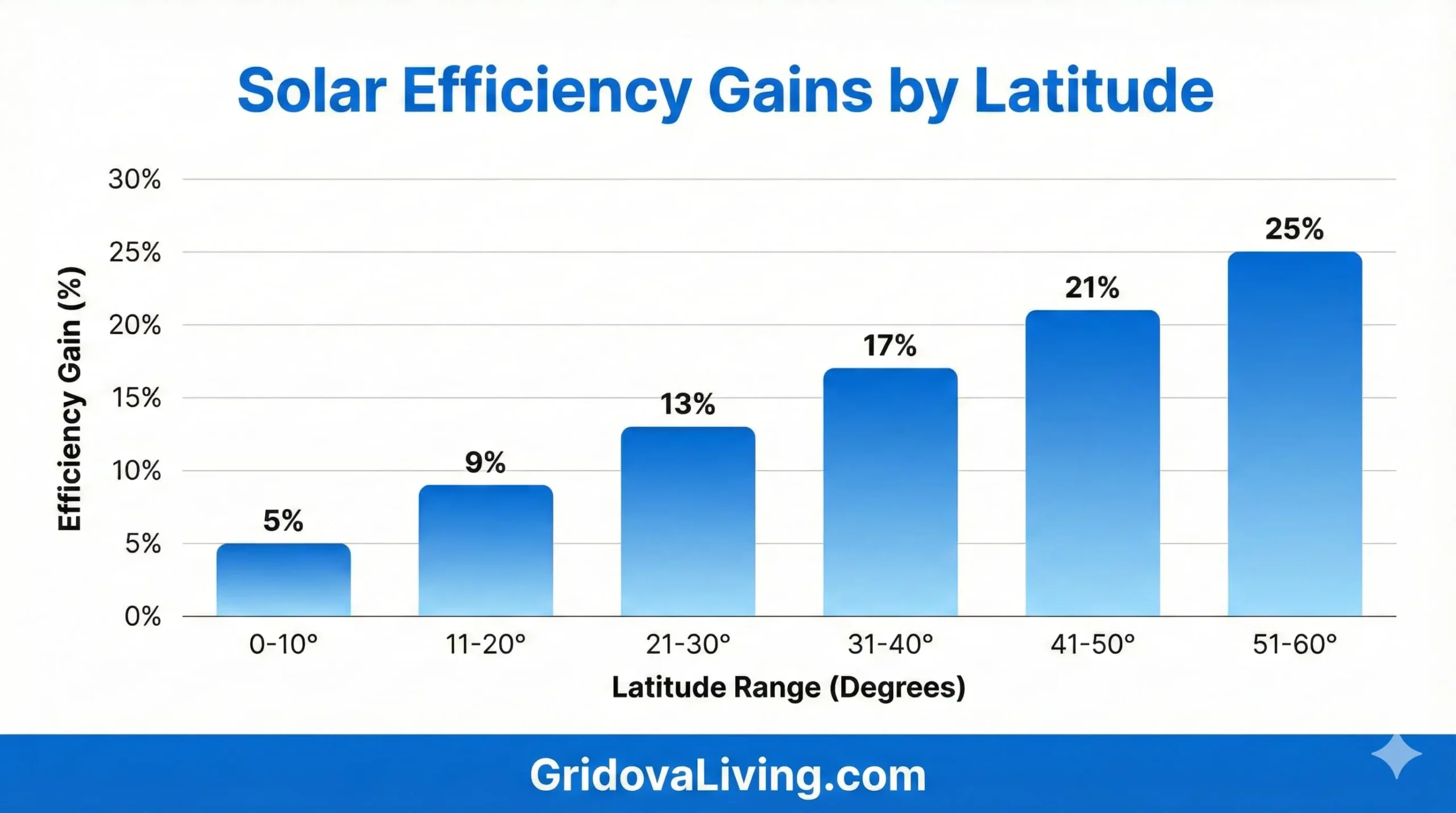
Solar Panel Tilt Angle by Latitude Chart
| Latitude Range | Year-Round | Summer | Winter | Efficiency Gain |
|---|---|---|---|---|
| 0-10° | 10° | 0-5° | 20-25° | 5-10% |
| 10-20° | 15° | 0-5° | 25-35° | 8-12% |
| 20-30° | 25° | 10° | 40° | 10-15% |
| 30-40° | 35° | 20° | 50° | 15-20% |
| 40-50° | 45° | 30° | 60° | 18-23% |
| 50-60° | 55° | 40° | 70° | 20-25% |
These efficiency gains assume you’re comparing optimized angles against horizontal mounting. Actual gains vary based on weather patterns, shading, and panel quality.
How to Adjust Solar Panel Tilt Angle
Adjusting tilt angle is straightforward if your mounting system includes adjustable brackets. Most ground mounts and portable solar panel kits come with pre-drilled holes at different angles. Here’s the step-by-step process I use twice a year:
Tools You’ll Need
- Socket wrench or adjustable wrench
- Digital angle finder or smartphone level app
- Safety gloves
- Ladder (for roof-mounted systems)
Adjustment Steps
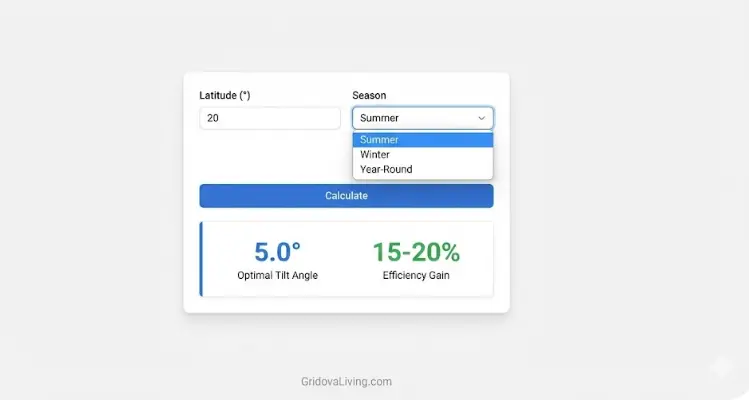
Step 1: Calculate Your Target Angle. Use the calculator above or the latitude formula. For most people, adjusting twice yearly (spring and fall) provides the best balance between effort and gain.
Step 2: Disconnect the System. Turn off your charge controller or inverter before touching panels. This prevents electrical shock and protects your equipment from voltage spikes during adjustment.
Step 3: Loosen Mounting Bolts. Most adjustable mounts have four bolts—two at the base and two at the pivot point. Loosen the pivot bolts just enough to move the panel, but keep base bolts tight for stability.
Step 4: Set the Angle. Tilt the panel to your target angle using your angle finder. Smartphone apps like “Bubble Level” work perfectly for this. Hold the panel steady and verify the angle from multiple positions to account for ground slope.
Step 5: Tighten and Test. Secure all bolts firmly, reconnect your system, and monitor output for a few days. You should see increased production during peak sun hours if the adjustment was successful.
On fixed roof mounts without adjustment capability, you can add tilt kits. These aluminum brackets cost 30 to 80 dollars per panel and bolt between your existing mount and the panel. I installed Renogy tilt brackets on my cabin roof, which increased winter production by 240 Wh daily—enough to keep my 12V fridge running without generator backup.
Seasonal vs Fixed Angle: Which Strategy Works Best?
Fixed angle installation at your latitude provides 85 to 90 percent of the energy you’d get from perfect seasonal tracking. For most off-grid homeowners, this represents the sweet spot between simplicity and performance. You install once and forget about it.
Seasonal adjustment—changing angle twice yearly—captures an additional 8 to 15 percent of annual energy production. This matters most if you live above 35 degrees latitude where seasonal sun angle variation is significant, or if you heavily rely on solar during winter months when sun is scarce.
I recommend fixed angles for:
- Roof-mounted systems where access is difficult
- Large arrays (20+ panels) where adjustment time becomes prohibitive
- Grid-tied systems with net metering where summer overproduction offsets winter shortfalls
- Locations between 10-30 degrees latitude where seasonal variation is minimal
Seasonal adjustment makes sense for:
- Ground-mounted systems with easy access
- Off-grid setups where every watt counts in winter
- Small arrays (2-6 panels) where adjustment takes under 30 minutes
- High latitudes (above 40 degrees) with dramatic seasonal sun changes
Full solar tracking systems—motorized mounts that follow the sun throughout the day—can increase production by 25 to 35 percent but cost 500 to 2000 dollars per panel. The payback period rarely justifies the investment for residential systems unless you’re in a commercial installation or have extreme energy needs.
Common Solar Panel Tilt Angle Mistakes
Ignoring Roof Pitch. Your roof angle might not match your optimal tilt angle. A 4/12 pitch roof (about 18 degrees) in Seattle (latitude 47 degrees) leaves nearly 30 degrees of potential optimization on the table. Either accept the compromise or add tilt mounts to correct the angle.
Forgetting Snow Load. Steeper angles (above 40 degrees) help snow slide off panels, maintaining winter production. I watched my neighbor’s flat-mounted panels stay covered for three days after a storm while mine at 55 degrees cleared within hours. This factor matters more than optimal sun angle if you’re in heavy snow country.
Over-Tilting in Summer. Some people think “more tilt equals more power” and set panels at 60-plus degrees year-round. This tanks summer production when sun is nearly overhead. Stick to the latitude-minus-15 formula for summer or use year-round latitude angles.
Not Accounting for Shading. Tilt angle affects shade patterns. Higher tilt angles can cause morning or evening shading from nearby trees or structures that wouldn’t shadow flat panels. Use a sun path app to verify your adjusted angle won’t create new shade problems.
Neglecting Wind Load. Steep tilt angles create more wind resistance. If you live in a high-wind area, ensure your mounting system is rated for the additional force. I lost a 100W panel during a windstorm because I tilted it to 70 degrees on a mount rated only for 45 degrees maximum.
Tools for Finding Your Optimal Angle

Beyond the calculator above, several smartphone apps and physical tools can help optimize your solar panel angle:
Sun Seeker (iOS/Android). This augmented reality app overlays the sun’s path on your camera view, showing exactly where the sun will be at any time of year. Point it at your installation site to visualize seasonal angle changes. Cost: 10 dollars.
Solmetric SunEye. Professional tool for solar installers that measures shading and calculates optimal tilt. Overkill for DIY but useful if you’re installing a large system. Cost: 2000-plus dollars (rent for 100 dollars per day from some tool rental shops).
Simple Angle Finder. A 15-dollar magnetic angle finder from any hardware store works perfectly. Stick it to your panel frame and adjust until you hit your target angle. No batteries or apps required.
Google Earth Pro. The desktop version lets you measure roof pitch and panel angles from satellite imagery. Navigate to your property, use the ruler tool in 3D mode, and calculate existing roof angles before installing panels.
Real-World Solar Panel Angle Performance Data
I tracked production data from my 1200W off-grid array over two years, comparing fixed 39-degree mounting against seasonal adjustments (25 degrees summer, 55 degrees winter). Location: Colorado at 39.5 degrees north latitude.
Fixed Angle (39 degrees year-round):
- Summer average: 5.8 kWh per day
- Winter average: 2.1 kWh per day
- Annual total: 1,460 kWh
Seasonal Adjustment:
- Summer average (25 degrees): 6.4 kWh per day
- Winter average (55 degrees): 2.5 kWh per day
- Annual total: 1,625 kWh
The seasonal adjustment delivered 165 kWh more annually—an 11 percent increase. At my off-grid propane generator cost of 30 cents per kWh, that’s 50 dollars saved yearly for about one hour of adjustment time twice per year. The math works clearly in favor of seasonal optimization for accessible ground-mount systems.
Winter gains were more dramatic than summer because low sun angles benefit significantly from steeper tilt. The 55-degree winter angle also shed snow faster, adding 3-4 extra production days during heavy snow months.
Frequently Asked Questions
Can I use the same tilt angle year-round?
Yes, setting panels at your latitude angle year-round provides 85-90 percent of optimal annual production. This fixed approach works well for most installations and eliminates the need for seasonal adjustments.
What if my roof pitch doesn’t match the optimal angle?
You have three options: accept the efficiency loss (usually 5-15 percent), install tilt brackets to correct the angle, or mount panels on a ground array or pole mount where you control the angle. Most people choose to accept the roof pitch unless the difference exceeds 20 degrees.
Do I need to adjust tilt angle monthly?
No, monthly adjustments provide minimal benefit over twice-yearly changes. Adjust once in spring (around April) to summer angle and once in fall (around October) to winter angle. This captures 90 percent of the benefit of perfect tracking with minimal effort.
How much does tilt angle matter compared to panel direction?
Panel azimuth (compass direction) matters more than tilt angle in most cases. South-facing panels (in the Northern Hemisphere) produce 20-30 percent more energy than east or west-facing panels at the same tilt angle. Get direction right first, then optimize tilt.
Will snow slide off panels at steeper angles?
Yes, angles above 35 degrees encourage snow to slide off, usually within 1-3 hours of snowfall ending. Angles below 25 degrees often hold snow for days unless temperatures rise significantly. This factor alone can justify steeper winter angles in snowy climates.
Can I adjust portable solar panels every day?
Portable panels and camping setups benefit from daily angle adjustments if you’re staying in one location. Point panels directly at the sun during peak hours (10 AM to 2 PM) for maximum output. Some portable systems include kickstands with angle markers for quick adjustment.
Related Solar Guides
Once you’ve optimized your panel angle, explore these related topics to maximize your solar system performance:
- Calculate Solar Panel Needs for Off-Grid Systems – Size your array correctly before installation
- Off-Grid Battery Bank Wiring Guide – Connect batteries properly to store your solar energy
- Solar Panel Angle by Latitude Complete Guide – Deep dive into latitude-based angle optimization
- Best Solar Panels for Off-Grid Living 2026 – Choose the right panels for your system
- MPPT vs PWM Charge Controller – Optimize charging efficiency with the right controller
- Solar Panel Cleaning Guide – Maintain peak performance with proper cleaning
Final Thoughts on Solar Panel Tilt Angle
Optimizing solar panel tilt angle is one of the simplest ways to increase energy production without buying additional panels. The latitude rule provides an excellent starting point, and seasonal adjustments can capture an extra 10-15 percent of annual energy for minimal effort.
Start with the calculator above to find your optimal angle, then decide whether fixed or seasonal adjustment fits your situation. Ground-mounted and portable systems benefit most from adjustment, while roof-mounted arrays often work fine at fixed angles matching your latitude.
Remember that tilt angle is just one factor in solar performance. Panel direction, shading, cleanliness, and component quality all play significant roles. Focus on getting the basics right—south-facing panels at approximately your latitude angle—and you’ll capture the vast majority of available solar energy at your location.

Lio Verdan writes about solar energy, off-grid living, and eco-innovation through Gridova Living — a platform dedicated to energy freedom and sustainable technology.