Adjust battery capacity, charge time, climate, and battery type to get personalized solar panel recommendations with estimated charge times and daily energy output.
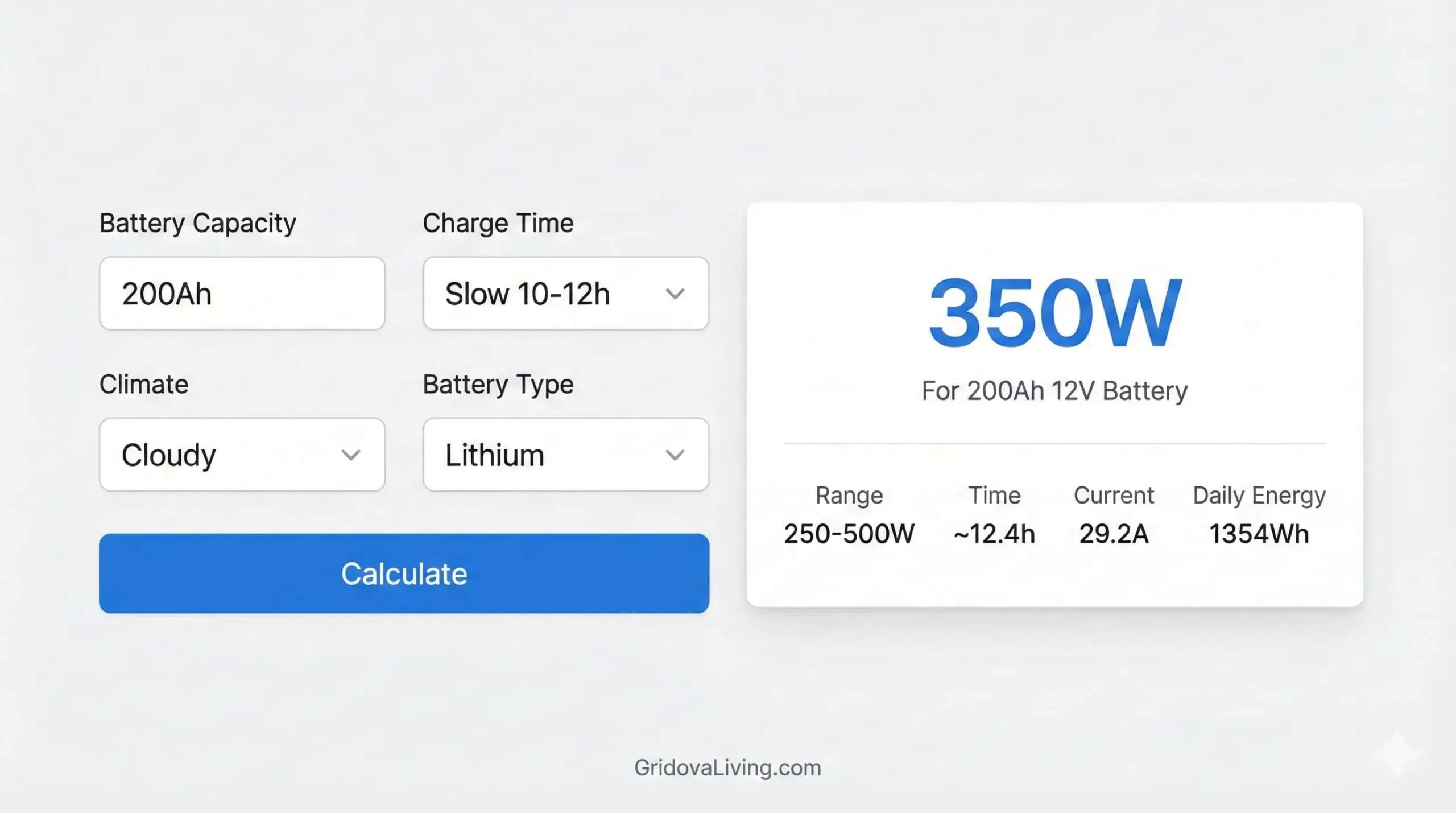
Interactive calculator showing recommended 400W solar panel for 100Ah battery in cloudy conditions
The Simple Formula
Here’s the basic math for sizing a solar panel to charge a 12V battery:
Battery capacity (Ah) × 12V ÷ sun hours = Minimum panel wattage
Example: 100Ah battery, 5 sun hours per day
100Ah × 12V = 1,200 watt-hours needed
1,200Wh ÷ 5 hours = 240W minimum panel
Add 20-30% for system losses (charge controller inefficiency, wire resistance, panel dirt):
240W × 1.25 = 300W panel recommended
That’s the technical calculation. Reality is usually simpler—most 12V battery systems work fine with a 100W to 300W panel depending on your daily power draw.
Quick Sizing Chart
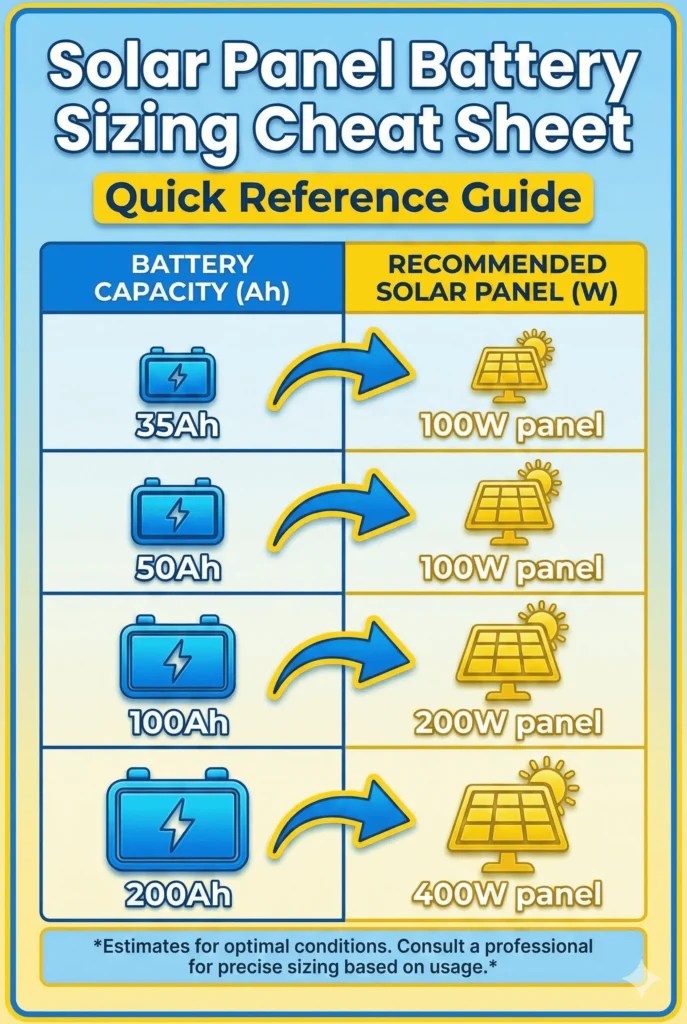
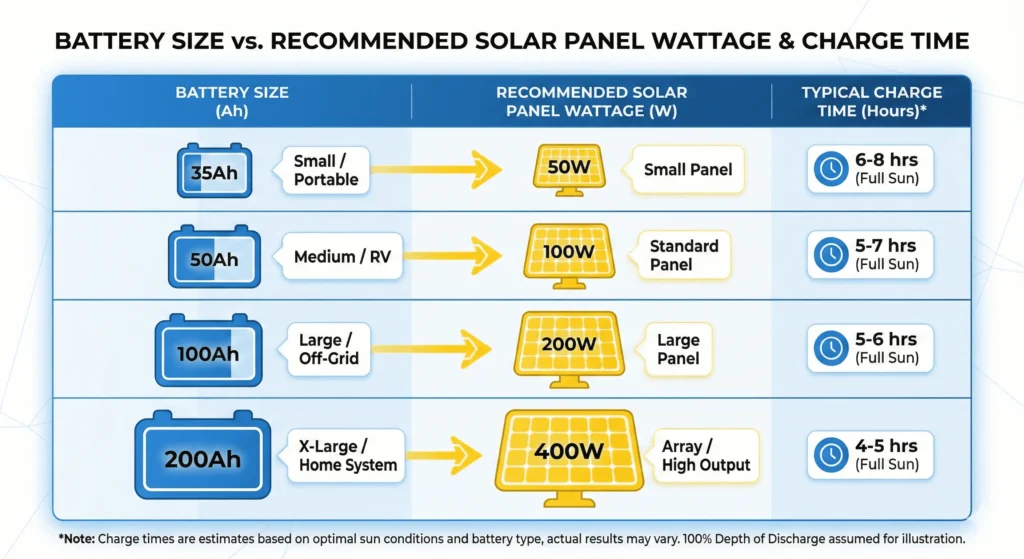
| Battery Size | Minimum Panel | Recommended Panel | Charge Time (Full Sun) |
|---|---|---|---|
| 35Ah (Small) | 50W | 100W | 4-6 hours |
| 50Ah | 75W | 100W | 5-7 hours |
| 100Ah (Standard) | 150W | 200-300W | 5-8 hours |
| 200Ah (Large) | 300W | 400-600W | 6-10 hours |
These assume 5 hours of good sun per day and charging from 50% to 100%. If you’re in a cloudy area or winter, bump up panel size by 30-50%.
What Actually Affects Charging Speed
Battery state of charge: Charging from 80% to 100% takes longer than 50% to 80%. The last 20% can take as long as the first 50%. This is normal battery chemistry—you can’t rush it.
Sun intensity: Full sun means the panel produces rated power. Cloudy day? Maybe 20-40% of rated power. Morning/evening sun? 50-70%. This is why people oversize panels—you’re rarely getting full rated output.
Temperature: Panels lose efficiency when hot. On a 90°F day, your panel might only produce 85% of rated power. Cold weather actually improves panel efficiency.
Charge controller type: PWM controllers waste about 20-25% of panel power. MPPT controllers are 95%+ efficient. If you’re using PWM, size your panel bigger to compensate.
Wire gauge and length: Thin wires over long distances lose power to resistance. Use proper wire gauge for your current and distance. Our battery wiring guide covers this in detail.
How Many Amp-Hours Do You Actually Use?
Before you size a panel, figure out your daily power consumption. No point charging faster than you drain the battery.
Light use (camping, phone charging): 10-20Ah per day. A 50W panel handles this easily.
Moderate use (lights, laptop, small fridge): 30-60Ah per day. You want 100-150W of solar.
Heavy use (full-time van life, multiple devices): 80-150Ah per day. Go with 200-400W of panels.
If you’re draining 50Ah per day from a 100Ah battery, you need to replace those 50Ah daily. In 5 sun hours, that’s 50Ah ÷ 5 = 10A charging current needed. At 12V, that’s 120W minimum. Round up to 150-200W for real-world conditions.
Different Battery Types Matter
Flooded lead-acid: Can handle high charge current. You can use a big panel and charge fast. But they need proper ventilation and regular maintenance.
AGM (sealed lead-acid): Similar to flooded but sealed. Can’t really overcharge them with solar since the charge controller prevents it. Good for most applications.
Lithium (LiFePO4): Can accept much higher charge current than lead-acid. A 100Ah lithium battery can safely take 50A+ charging current, so you can use bigger panels without issues. They also charge faster—no long absorption phase like lead-acid.
For lithium batteries, you can be more aggressive with panel sizing. A 100Ah lithium can easily handle 300W+ of solar. Lead-acid is typically limited to 20-25A charging current (240-300W for 12V systems).
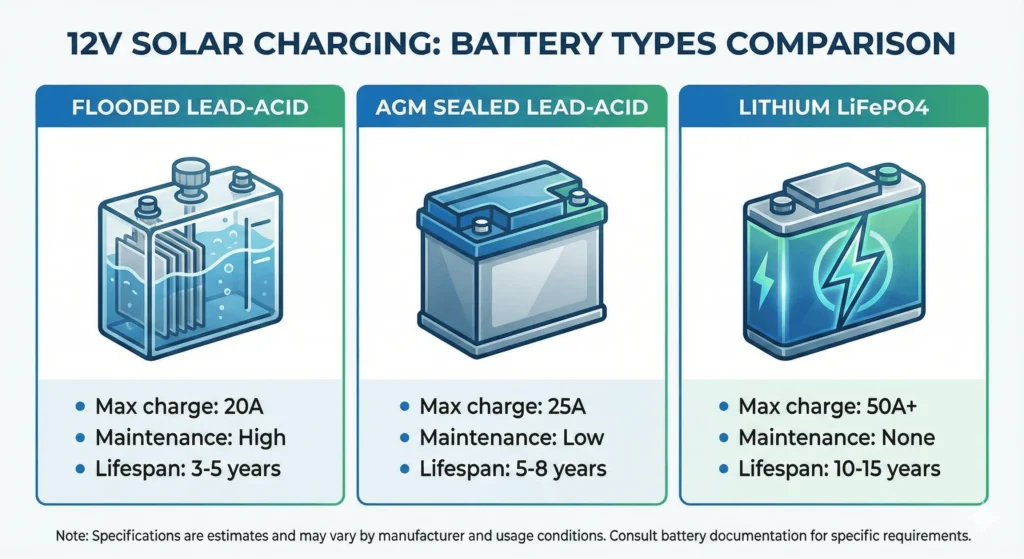
Charging characteristics: Flooded vs AGM vs Lithium batteries
If you’re choosing between battery types, check our battery storage guide for the full comparison.
Charge Controller: PWM vs MPPT
Your charge controller type significantly affects what panel size works.
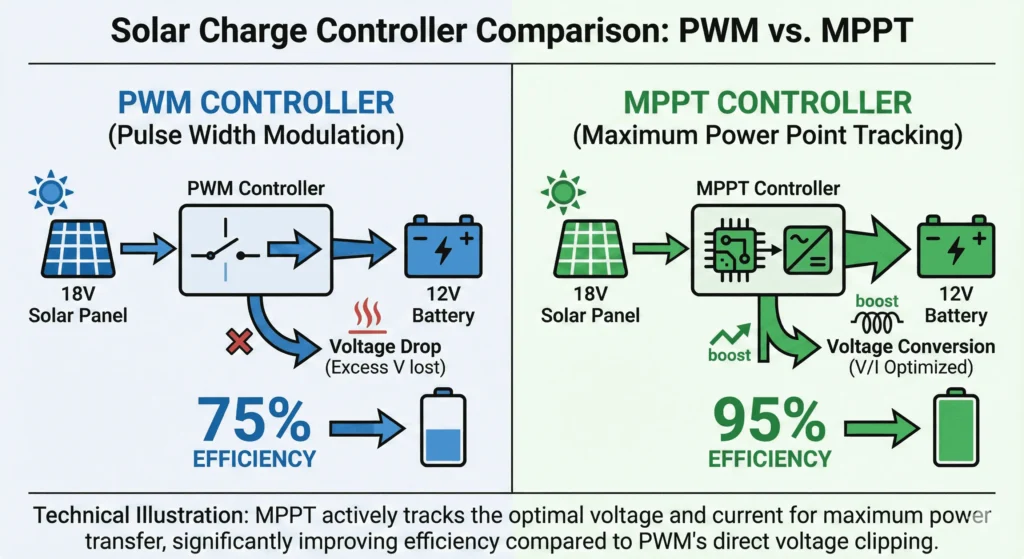
PWM controllers are cheaper but less efficient. They pull the panel voltage down to match battery voltage. If you have an 18V panel charging a 12V battery, you’re wasting that extra voltage. Efficiency is about 75-80%.
With PWM, your panel voltage should closely match your battery voltage. For 12V batteries, use panels labeled as “12V” (actually 17-18V open circuit). Panel wattage directly translates to charging power, minus 20-25% losses.
MPPT controllers cost more but extract maximum power from panels. They convert excess voltage into additional current. Same 18V panel can deliver nearly its full rated power to a 12V battery. Efficiency is 95%+.
With MPPT, you can use higher voltage panels (24V, 36V) on 12V batteries. This gives you more panel options and better performance, especially in less-than-ideal conditions.
Bottom line: If using PWM, size your panel assuming 75% efficiency. If using MPPT, size assuming 95% efficiency. For detailed setup instructions, see our inverter and charge controller guide.
Real-World Examples
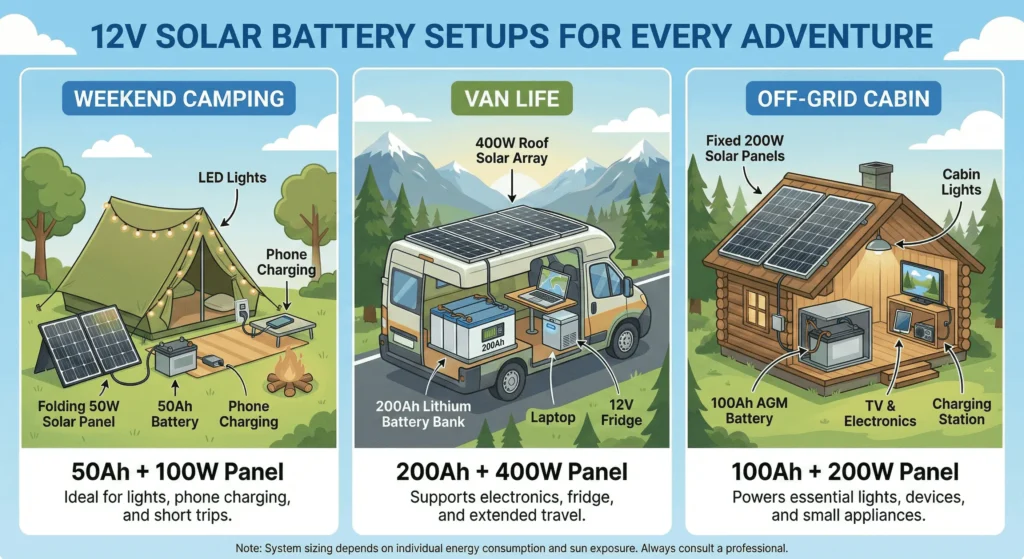
Common 12V solar setups: camping, van life, and off-grid cabin
Example 1: Weekend camping setupBattery: 50Ah AGM
Daily use: 15-20Ah (LED lights, phone charging, small fan)
Panel: 100W with PWM controller
Charge time: 3-4 hours in good sun
This works because you’re only using 30-40% of battery capacity daily. The 100W panel easily replaces what you use and tops off the battery before sunset.
Example 2: Van life full-time
Battery: 200Ah lithium
Daily use: 80-100Ah (laptop, lights, water pump, 12V fridge)
Panel: 400W with MPPT controller
Charge time: 5-6 hours to fully recharge
The 400W panel might seem like overkill, but it ensures you can fully recharge even on partly cloudy days. Lithium batteries can handle the high charge current, so the big panel isn’t a problem.
Example 3: Off-grid cabin backup power
Battery: 100Ah AGM
Daily use: 40-50Ah (occasional lights, phone charging, radio)
Panel: 200W with MPPT
Charge time: 4-5 hours
Oversized slightly because this is backup power—needs to work reliably even in winter with shorter days and weaker sun. The extra capacity provides peace of mind.
Can You Use Too Big of a Solar Panel?
Not really, as long as you have a proper charge controller.
The charge controller regulates current to prevent overcharging. Once the battery is full, it stops accepting charge. The panel will just sit there producing power that isn’t being used—which is fine.
The only real downside to oversizing is cost. A 300W panel costs more than a 100W panel. If you only need 100W, spending extra on 300W doesn’t help unless you plan to expand your system later.
For lithium batteries specifically, bigger panels are rarely a problem. They can accept high charge current without damage. For lead-acid, you technically shouldn’t exceed C/5 charging rate (20A for 100Ah battery), but solar rarely delivers that much current consistently anyway due to sun angle and weather variations.
Portable Solar Panels for 12V Batteries
If you’re looking for a simple plug-and-play solution, portable solar panels work well for small 12V battery setups.
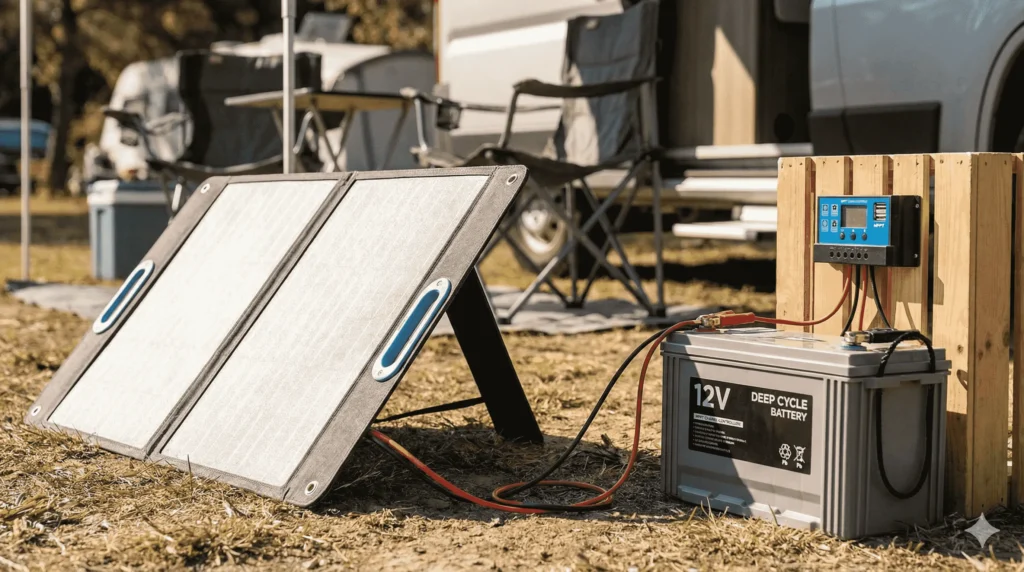
Most portable panels come in 100W, 200W sizes with built-in charge controllers. Just connect to your battery terminals and you’re charging. These are great for RVs, boats, or emergency backup power.
Look for panels with MC4 connectors and make sure the built-in controller matches your battery type (some don’t work properly with lithium). For a reliable portable option, check out the Renogy 100W portable solar panel which includes everything you need to start charging.
If you need more power, you can connect multiple portable panels in parallel. Two 100W panels give you 200W total charging capacity.
How Many Hours of Sun Do You Really Get?
This trips people up. “Sun hours” doesn’t mean hours of daylight. It means hours of useful charging sun—roughly 10am to 4pm when the sun is high enough for good panel output.
Most US locations get 4-6 peak sun hours per day on average. Desert areas might get 6-7. Pacific Northwest might get 3-4. Winter reduces this significantly—you might only get 2-3 hours in December.
Check your location’s average peak sun hours before sizing your panel. If you get 3 hours instead of 5, you need a bigger panel to collect the same total energy.
For example: 100Ah battery in Arizona (6 sun hours) needs 200W panel. Same battery in Seattle (3.5 sun hours) needs 300-350W to charge in one day.
What If You Can’t Fully Charge Every Day?
That’s fine occasionally, but not long-term.
Lead-acid batteries don’t like being partially charged for extended periods. Sulfation builds up on the plates, reducing capacity over time. Try to fully charge at least every few days.
Lithium batteries are more forgiving. They can sit at partial charge without damage. But you still want to top them off regularly to maximize available capacity.
If your panel can’t fully charge the battery daily in your climate, either get a bigger panel or reduce your daily power consumption. Or accept that you’ll need to plug into shore power or run a generator periodically.
For more on keeping your batteries healthy, see our battery maintenance guide.
Installation Tips
Tilt your panel toward the sun. Flat-mounted panels lose 20-30% efficiency. Angled at your latitude gives best year-round performance. Adjustable mounts let you optimize for season.
Avoid shade completely. Even small shadows kill panel output. A shaded corner can reduce total output by 50%+. Mount panels where they’ll get full sun all day.
Keep wiring short and thick. Use 10 AWG wire minimum for runs under 10 feet. Go thicker for longer distances. Voltage drop in thin wires wastes power.
Mount securely. Panels catch wind. Use proper brackets and hardware rated for your panel weight and wind load. I’ve seen panels rip loose in storms—not worth the risk.
Add a fuse. Put a fuse on the positive wire close to the battery. If something shorts, the fuse blows instead of your wiring catching fire. 15A fuse is typical for 100-200W panels.
Common Mistakes
Using a panel that’s too small: It’ll charge your battery, just very slowly. If you use 50Ah daily and your panel only provides 30Ah, you’re draining the battery over time. This kills batteries fast.
Skipping the charge controller: Never connect a solar panel directly to a battery without a controller. It’ll overcharge and damage the battery. Always use a proper charge controller between panel and battery.
Wrong charge controller settings: If your controller is set for flooded lead-acid but you have AGM, the voltage settings are wrong. This leads to undercharging or overcharging. Match controller settings to your battery type.
Not accounting for system losses: People calculate they need 100W, buy exactly 100W, then wonder why it doesn’t work. Real-world efficiency is 70-80%. Always oversize by 20-30%.
Using thin wire: 18 AWG wire on a 100W system loses significant power to resistance. Use proper gauge wire for your current. This matters more than people think.
What happens if my solar panel is too small for my battery?
It’ll charge the battery, just slowly. If the panel can’t replace your daily usage, the battery gradually drains over time. This isn’t dangerous, but you’ll need another charging source (shore power, generator) periodically.
Can I charge a 12V battery with an 18V solar panel?
Yes, that’s actually ideal. “12V” solar panels are typically 17-18V to properly charge 12V batteries. You need higher voltage than the battery to push current in. Just use a charge controller—never connect directly.
How long to charge a dead 12V battery with solar?
Depends on battery size and panel wattage. A completely dead 100Ah battery needs about 1,200Wh. With a 200W panel in good sun (5 hours), that’s 1,000Wh per day. So roughly 1.5-2 days to fully charge from dead, assuming decent sun.
Do I need a charge controller for a small solar panel?
Yes, always. Even a 10W panel can overcharge a small battery if left connected long enough. Charge controllers are cheap insurance against battery damage. Don’t skip this.
Can I connect multiple solar panels to one 12V battery?
Absolutely. Connect panels in parallel to increase charging current. Make sure your charge controller is rated for the total wattage. Two 100W panels = 200W total, so you need a controller that can handle 200W+.
What size solar panel for 100Ah lithium battery?
200-300W is ideal. Lithium can accept faster charging than lead-acid, so bigger panels work well. A 300W panel can charge a 100Ah lithium battery in 4-5 hours of good sun, even accounting for system losses.
Will a 100W solar panel overcharge my battery?
Not if you have a charge controller. The controller stops charging when the battery is full. Without a controller, yes, a 100W panel can overcharge and damage a battery over time.
Final Thoughts
Sizing a solar panel for a 12V battery isn’t complicated once you know the basics. Figure out your daily amp-hour usage, account for your location’s sun hours, add margin for system losses, and you’re done.
Most people land on 100-300W panels for typical 12V battery systems. Go smaller only if you’re barely using any power. Go bigger if you’re in a cloudy climate or using lots of power daily.
When in doubt, oversize slightly. The cost difference between a 200W and 300W panel is usually minimal, but the extra capacity means you’ll charge reliably even on less-than-perfect days.
And remember: the panel is just one piece. Get a proper charge controller, use correct wire gauge, mount the panel well, and match everything to your battery type. Do that and your system will work reliably for years.
If you’re building a complete off-grid power system, start with our complete solar system sizing calculator to plan everything correctly from the beginning.

Lio Verdan writes about solar energy, off-grid living, and eco-innovation through Gridova Living — a platform dedicated to energy freedom and sustainable technology.